Showing posts with label rehearsal. Show all posts

Sunday, April 4, 2010

First Run Through: Fragile Things, Magic and Darkness

I was having one of those late-night-into-early-morning bouts of insomnia. Where a single worry or two seem to invite another and another and they, in turn, are acquaintances of some of my old fears and a few old embarrassing moments and so they come along too “to relive old times” and finally the party is in full swing and it is four in the morning. So I gave up trying to sleep and decided to wait for the sleepy comfort of dawn. The cats were perplexed by the change in routine but were willing to sit next to me on the couch and wait for breakfast while I typed.

I turned to thinking about the first run through I saw on Monday. It is part of a sacred trust as a collaborator with other artists on a play not to reveal the first rough steps of a production. An audience must wait to see a polished gem not a bumpy rock. (Which is not to say that this rehearsal was that bumpy; I thought it was in rather good shape.) I can however reflect on the process though not the details of it. A first rehearsal is a delicate creature. I have heard other dramaturgs refer to their role on a production as midwife to a play and I have never been sure I agreed with the analogy. However, a play newly on its feet (which is often what we refer to the process as getting a play on its feet) is very much like a newborn creature, full of wrinkles and fits and starts as it struggles to stand up. Newborn creatures are not generally lovely right away. But like other newborn creatures it inspires a protectiveness to guard and help until it can stand on its own and defend itself as best it can.

If you are not a participant in theater, then you should appreciate the job the actors have to do at a first run through of a play. They are remembering new blocking, and lines, thinking about the development of their characters, working on dialects and fight choreography all while still working in an empty room with tape on the floor to indicate doors, or steps or ladders. Often this is after putting aside the concerns of a day job and fueled by caffeine while fighting a cold.

Designers come to a first run through and do not generally make a good audience. Not because they don’t enjoy the play but because they are thinking about their various tasks and may have heads bent over notepads or laptops writing questions about a sound cue or how a set piece might function or some costume change that might be needed, or could some story arc be made more clear.

The Marquis de Carabas tells the stranded Richard,You’ll just have to make the best of it down here in the sewers and the magic and the dark.” The act of making theater, the contract between an audience and actors who agree to sit in a dark room and share an experience that is meant to move them is source of continual fascination to me no matter how long I work in theater.
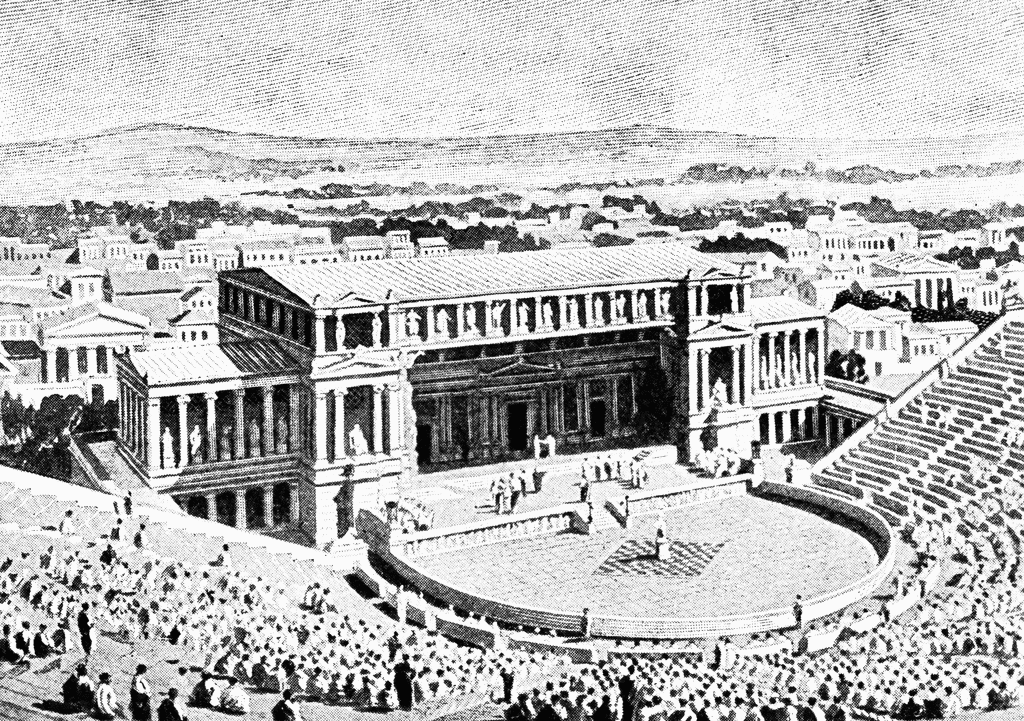
It is no surprise then that the earliest acts of theater are associated with religious rituals. One can imagine the day a hunter at night by a fire told the story of the hunt and the moment another person took up the skin of a gazelle and pretended to be the creature hunted. It is easy to see how the recreation of a fierce hunt for those who didn’t see it but are about to enjoy the meal might become a mystical play. Early Greek theater was part of religious festivals and a shared communal experience. So even though theaters today are not generally tied to religious practice and they often struggle for their financial existence in a world of many competing entertainment voices; there are still those struggling to create fragile things and delicate creatures and there is still something that draws audiences to share the magic and the dark.


Wednesday, March 10, 2010

First Rehearsal: Instructions, Beginnings and Tribes

At certain first rehearsals there is a sort of alchemy that happens where you look around the table at the set design and the costume designs and hear the sound designers play clips. It is magic to hear the actors start reading a script and hear the voices from the page aloud and laughter at the funny bits.

It is also exciting to feel like you are embarking on a journey with people who care about the same things. This was a good first rehearsal. The designs were fantastic and there was this feeling in the room of how excited each person was to be working on Neverwhere. Paul and the cast read aloud Gaiman's poem, Instructions, (instructions for what to do if you are in a fairy tale) which seems like a good way to start. Like Richard we are all embarking on journey, however we have the luxury of a group to help us. So here are some musings on Richard's journey and our own journey.

I have been thinking about tribes. Theater is certainly its own tribe. There are tribes in London Below (or fiefdoms and duchies).

I recently heard a discussion of the theories of the political philosopher, Hannah Arendt, they resonated with the line from the beginning of Neverwhere when the old woman tells Richard's fortune. Part of Arendt's statement that struck me, in rough paraphrase, is that a beautiful soul is not enough to live fully and securely, every human being needs the social and political status that comes with full membership. The old woman tells Richard,
"You've a good heart. Sometimes that's enough to see you safe wherever you go. But mostly, it's not." Without trying to minimize or simplify Arendt's theories, I think both thoughts get at some of the key ideas in Neverwhere, that is that being having a good heart or a beautiful soul is not valued, it is in fact a liability, but also that we want membership in a social group to live securely.

Richard's decency in helping Door is not appreciated by London above, or in many ways by London below. In fact in both worlds we see acts of great selfishness it is under a veneer in London above that Jessica doesn't care about an injured girl or that Mr. Stockton doesn't really care about art or the guests. In London Below the stakes are higher, Lord ratspeaker would happily slit his throat. London below is more extreme because existence is more extreme but the motivations, selfishness among them are the same.

Richard is not only disoriented by the foreignness of London below but also by the lack of a group of friends who help give him definition. When Richard enters London below he is tribe-less. He is continually being asked to whom he swears fealty, which duchy, which fiefdom? Part of Richard's desperation to return to London above is to be part of the established and familiar social order. He breaks down and cries when he has lost his identity in London Above and when Door, Marquis and Hunter have left him. He wants to belong.

In truth, in London above he doesn't have a tribe either, but he is lulled by the normalcy of everything around him into thinking his life, his work, his fiancee are all fine. Whey he returns from his time in London below he lost again, and finds work, going out for drinks are meaningless. He tells Jessica he's changed. This is why the challenge is so harrowing. He is forced to face the loss of a group that could give him definition but also he conjures the images of his former fiancee and friend to tell him he is insane and worthless. He must decide if his live is worth living without the certainty of others to define him and yet it is the recollection of the generosity and loss of Anasthesia that recalls him to his senses.

Interestingly, Henry Mayhew, journalist, social researcher and editor of Punch, who wrote the 1851 London Labour and the London Poor, refers to the various groups that he interviews in the London underclasses as tribes. But even while his approach is anthropological he wants to understand the costermonger and the orange a lemon seller. It is that same curiosity that infects Richard Mayhew. He keeps asking, Door, the Marquis and Hunter questions about the peoples of London below, he wants to understand the world.

What interests me about Richard's journey is not just the journey (that story is familiar to us and Joseph Campbell's The Hero's Journey has described separation, initiation and return and it is interesting see that journey) but after then end of the journey, after the return. What happens then? Fairy tales always get us home but they don't talk about what happens after you get home.

When I was a child, I was always frustrated by children having to go back after having an incredible journey. Back out of the wardrobe, out of the rabbit hole, back to Kansas, to the Dursleys. I didn't want them to go home much in the way that I didn't want the stories to end. Richard has changed, almost without knowing it. He is back home and discovers he his allegiances have changed, in a world that may be dangerous but after technicolor who wants to go back to black and white. Richard can see a life of security in London above but he forsakes that security. It makes me think of the last line of Instructions, "And then go home, Or make a home, Or rest."

I am glad to be on this journey with a tribe of like-minded individuals, who switch from Cockney to Irish in a heartbeat and design magical clothes and sets and lights and sounds. Where else would I get the chance to exchange emails about how best to create a piece of tang dynasty pottery that can be eaten several shows a week.

Oh and one mores thought, when we left the first rehearsal the misty day had turned into a thick fog, a peasouper, which seemed auspicious for our production. It smiled as I drove (slowly) all the way home and saw the strange shapes of gravestones in the cemetery and the dangerous trees in the park and the pale yellow glow of street lamps in the fog. It is late now and I think I choose rest.