Showing posts with label RichardRIchardMayhewDick. Show all posts

Sunday, March 21, 2010

London Above: Blindness and Sight


I have been thinking about the characters we see in London above that are from London Above: Jessica, Gary, Sylvia and Mr. Stockton. The new renters or Richard's flat. Almost every moment we see in the world of London above is associated with business or status. Richard works in the financial industry as do Gary and Sylvia and the descriptions of his actual work are coded in the jargon of the industry so as to be as obtuse as the hieroglyphics. Anaesthesia asks him "what's an investment an-thing." He is plunged into a world of bartering, favors and strange alliances where his matches and used hankie take on a new value but his credit card is worthless.
Perhaps it is because I have been dipping into Henry Mayhew's London Labour and the London Poor, but it feels very deliberate that the world of London above is tied to money and status. Richard discovers in London Below that his whole life had prepared him to be an investment analyst but it hadn't prepared him to survive particularly well in London Below. Actual survival skills have ceased to be necessary in London Above and it is highly abstract work with an ambiguous monetary system that allows Richard to have a London apartment and a girlfriend who thinks she can make him into the correct marriage prospect.

Jessica and Mr. Stockton are not in finance but they are in a world peopled almost entirely with the wealthy and famous, who behave appallingly at the opening or "Angels of England."

In 1956, anthropologist, Horace Miner, famously published The Body Ritual of the Nacirema. In which he wrote up descriptions of modern Americans as an anthropologist studying a foreign tribe. Nacirema is American spelled backwards. It now seems to be a popular article to pull out in high school sociology or history classes to make students look at the common practices of a society with fresh eyes. This is what Richard has to do when plunged into London below.

It is telling that in the ordeal it is the faces of Jessica and Gary that come back to him, the faces of what his normal live and goals and values have been. Richard must struggle to hang onto a sense of self that is separate from what failure leading to suicide would be in London Above.


This does not mean that the characters in London below are idealized. They are often selfish, unscrupulous and dangerous but their traits are much more readily identifiable than in London Above. I actually have some sympathy for Jessica and Gary. Jessica is terribly hurt that Richard had changed and doesn't understand it. Gary thinks that Richard may be going off the deep end when he is back and still not satisfied. They both don't have the painfully won self-knowledge that Richard has gained. Jessica is not evil she is self-involved, fairly callous to the homeless but she is operating with in perfectly acceptable standards for success within her society. The same is true of Gary. He is unseeing and perfectly content in his world of work, pubs and women. Thus the refrain from London above is that above-worlders don't see anything.
This leads me to two other characters. The first is the old woman who tells Richard's fortune at the beginning; she first thinks he is homeless because she has been homeless herself. She tells him to beware of doors and that his good heart might be enough to see him through. She is the proverbial seer who links London Above and London Below and links Richard to his future but in the classic fashion of Seers, Richard fails to understand her.

The second is the abbot of the black friars who is blind. "The abbot regarded his own blindness neither as a blessing nor as a curse: it simply was. . ." But in the abbot's darkness he knows another pilgrim is going to arrive and attempt the ordeal. He has a measure of foresight but his sin is waiting because he knows a pilgrim is coming and he ceases to live in the present. However, the abbot does not anticipate how Richard will survive the ordeal.

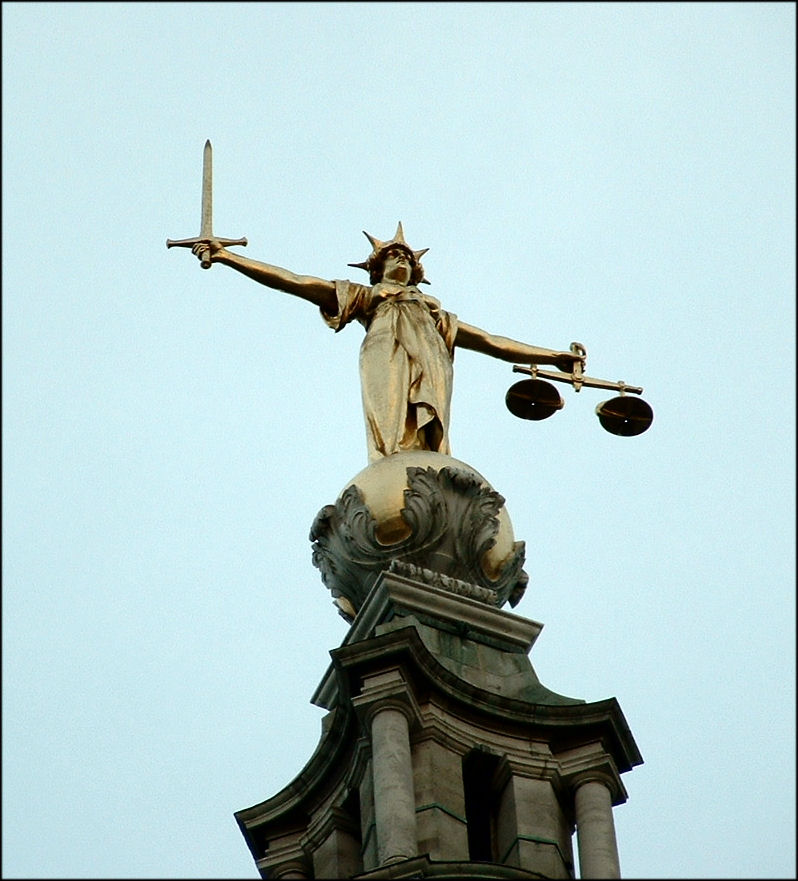
Seers are associated with blindness but so is Justice. The statues picture here are of Justice, which has long been depicted as blindfolded with sword and scales. The first is on top of the Old Bailey, the criminal court in London, the second is outside the supreme court of Canada (it just looks more menacing and mysterious). Yet, so much of Neverwhere there is not justice. It is not fair that Door's family has been murdered; it is not fair that Richard's life is taken away by being a Good Samaritan. Door seems to hesitate every time revenge is suggested as the motivating factor in her quest. She never seems to be trying to mete out justice herself but to see, to understand her unfathomable loss. Sight in Neverwhere becomes a more nuanced thing purchased at great price. Richard and Door can't go back to the way things were they can only come through them to with a clearer vision. It is a much more sophisticated idea than that everything will just be made okay again by an omnipotent source. It is telling that Door, Richard and the Marquis end up back at the black friars who are not there to make everything as it was but to help heal their wounds.


Wednesday, March 10, 2010

First Rehearsal: Instructions, Beginnings and Tribes

At certain first rehearsals there is a sort of alchemy that happens where you look around the table at the set design and the costume designs and hear the sound designers play clips. It is magic to hear the actors start reading a script and hear the voices from the page aloud and laughter at the funny bits.

It is also exciting to feel like you are embarking on a journey with people who care about the same things. This was a good first rehearsal. The designs were fantastic and there was this feeling in the room of how excited each person was to be working on Neverwhere. Paul and the cast read aloud Gaiman's poem, Instructions, (instructions for what to do if you are in a fairy tale) which seems like a good way to start. Like Richard we are all embarking on journey, however we have the luxury of a group to help us. So here are some musings on Richard's journey and our own journey.

I have been thinking about tribes. Theater is certainly its own tribe. There are tribes in London Below (or fiefdoms and duchies).

I recently heard a discussion of the theories of the political philosopher, Hannah Arendt, they resonated with the line from the beginning of Neverwhere when the old woman tells Richard's fortune. Part of Arendt's statement that struck me, in rough paraphrase, is that a beautiful soul is not enough to live fully and securely, every human being needs the social and political status that comes with full membership. The old woman tells Richard,
"You've a good heart. Sometimes that's enough to see you safe wherever you go. But mostly, it's not." Without trying to minimize or simplify Arendt's theories, I think both thoughts get at some of the key ideas in Neverwhere, that is that being having a good heart or a beautiful soul is not valued, it is in fact a liability, but also that we want membership in a social group to live securely.

Richard's decency in helping Door is not appreciated by London above, or in many ways by London below. In fact in both worlds we see acts of great selfishness it is under a veneer in London above that Jessica doesn't care about an injured girl or that Mr. Stockton doesn't really care about art or the guests. In London Below the stakes are higher, Lord ratspeaker would happily slit his throat. London below is more extreme because existence is more extreme but the motivations, selfishness among them are the same.

Richard is not only disoriented by the foreignness of London below but also by the lack of a group of friends who help give him definition. When Richard enters London below he is tribe-less. He is continually being asked to whom he swears fealty, which duchy, which fiefdom? Part of Richard's desperation to return to London above is to be part of the established and familiar social order. He breaks down and cries when he has lost his identity in London Above and when Door, Marquis and Hunter have left him. He wants to belong.

In truth, in London above he doesn't have a tribe either, but he is lulled by the normalcy of everything around him into thinking his life, his work, his fiancee are all fine. Whey he returns from his time in London below he lost again, and finds work, going out for drinks are meaningless. He tells Jessica he's changed. This is why the challenge is so harrowing. He is forced to face the loss of a group that could give him definition but also he conjures the images of his former fiancee and friend to tell him he is insane and worthless. He must decide if his live is worth living without the certainty of others to define him and yet it is the recollection of the generosity and loss of Anasthesia that recalls him to his senses.

Interestingly, Henry Mayhew, journalist, social researcher and editor of Punch, who wrote the 1851 London Labour and the London Poor, refers to the various groups that he interviews in the London underclasses as tribes. But even while his approach is anthropological he wants to understand the costermonger and the orange a lemon seller. It is that same curiosity that infects Richard Mayhew. He keeps asking, Door, the Marquis and Hunter questions about the peoples of London below, he wants to understand the world.

What interests me about Richard's journey is not just the journey (that story is familiar to us and Joseph Campbell's The Hero's Journey has described separation, initiation and return and it is interesting see that journey) but after then end of the journey, after the return. What happens then? Fairy tales always get us home but they don't talk about what happens after you get home.

When I was a child, I was always frustrated by children having to go back after having an incredible journey. Back out of the wardrobe, out of the rabbit hole, back to Kansas, to the Dursleys. I didn't want them to go home much in the way that I didn't want the stories to end. Richard has changed, almost without knowing it. He is back home and discovers he his allegiances have changed, in a world that may be dangerous but after technicolor who wants to go back to black and white. Richard can see a life of security in London above but he forsakes that security. It makes me think of the last line of Instructions, "And then go home, Or make a home, Or rest."

I am glad to be on this journey with a tribe of like-minded individuals, who switch from Cockney to Irish in a heartbeat and design magical clothes and sets and lights and sounds. Where else would I get the chance to exchange emails about how best to create a piece of tang dynasty pottery that can be eaten several shows a week.

Oh and one mores thought, when we left the first rehearsal the misty day had turned into a thick fog, a peasouper, which seemed auspicious for our production. It smiled as I drove (slowly) all the way home and saw the strange shapes of gravestones in the cemetery and the dangerous trees in the park and the pale yellow glow of street lamps in the fog. It is late now and I think I choose rest.

Monday, January 11, 2010

Marinating and Pondering Journeys

Been a while since I posted - sorry for that.  I've been enjoying some R&R after the holidays and simply marinating on some things, reading and making notes. 

Under the tree for me this year was "Prince of Stories: The Many Worlds of Neil Gaiman" which is a passionate guide to Gaiman's work published before Fall 2008.  A great reference of the behind the scenes development of the man's career and just a fun read.  In it I learned that Mr. Croup and Mr. Vandemar make an appearance in "Mr. Punch" which means I must stop by my local comic shop and investigate.

On Saturday the 2nd, Maren and I went to the Art Institute of Chicago to visit the collection of Victorian photo-collage art that recently passed through, our interest sparked by the art of the music video costume designer Elizabeth Wislar shared with me a few months back.  Ultimately the art is not relevant to our production values but was an illuminating immersion into the bizarre and fantastic minds of the idle Victorian woman, influenced heavily by Darwin and Lewis Carrol. 

Last Wednesday I had a fascinating chat with Rob over some beers and BBQ. He's in the midst of some thinking and pondering on the script before diving into more writing probably in February he shared with me notes and thoughts and ideas from feedback given to him after our reading a few weeks ago. Our discussions continue to delve deeper into Richard's character arc; where is he at the beginning, where is his shift, and where does he end up.  There is something very interesting to me about Richard being a blithe participant in the modern cultural machine, a cog, a brick in the wall, at the beginning of the play.  He's absent minded and doesn't seem to be able to make any long term goals. He has no vision and little purpose.  As he gets wrapped up into the adventures of London Below, he continues to go along with what's demanded of him, more or less with bravery but without much personal investment.  He feels somehow deep inside that he must intervene and protect Door when and where he can.  When he loses Anesthesia on Night's Bridge, he experiences what may be his first profound sense of responsibility.  Further trust and emotional investment and even vulnerability with Door deepen his personal connection to the quest before him and in The Ordeal Of The Key there is a deeper, more radical shift. 

What The Ordeal is, what it actually symbolizes and provides for Richard, has been a challenge for Rob and I to articulate.  There is a tricky combination of Richard struggling with his sense of what is Real vs. what is Imagined and his being urged to off himself.  What he ultimately wins, besides the key, is a grounding - he feels more deeply and truly that he has purpose and that he is Doing The Right Thing.  And he gains that knowledge by rediscovering Anesthesia's necklace and confronting that guilt and loss.  He then becomes something of a leader, more confident, less whiny.

Fighting the Great Beast of London is the next evolution of Richard's character, but one I wonder if it may be even more felt later, when Richard returns to London Above.  At that point in the story, when Hunter dies and passes a torch of sorts to Richard, he must quickly go forward to complete the quest. Time is of the essence and self-reflection is a luxury he cannot afford. But when he finally gets what he's been wanting all along, like Dorothy, to just go home again, he's left feeling deeply dissatisfied.  At the moment of killing the Great Beast and painting its blood on his face, he becomes The Warrior.  How could he go back to paper pushing then?

Our next production meeting is coming soon.  Between now and then I am:
  1. rereading the script and pondering the logistics of the transitions and what they may mean tech wise
  2. considering the many pros and cons of using liquid blood on stage - a HUGE question
  3. investigating the use of puppets (rats, pigeons and the Great Beast) and thinking logistically of which actor will do what and how should they be seen, what are they in the world when they are manipulating a puppet

Friday, December 11, 2009

The Floating Market at Harrods

The night I made my way to check out the location in Harrods famous department store where Hunter is hired to be Door's bodyguard, my camera decided to take some shoddy pictures. Regardless...
I ended up at Knightsbridge, of course.


(Interesting tile work here at Hyde Park Corner, one stop away.)


Harrods was decked out in green not for the holidays (too early for that) but for the 70th anniversary of the movie The Wizard of Oz.


"The Meat and Fish Hall" inspires by name the image of a spacious, cavernous room.  Meeting by the "fish statue" evokes a museum like space, populated by artwork and marble.  Well, it's almost like that.  But with the amount of intense fighting involved, there is just too much in this room! It wouldn't fit an arena - these masters of combat are fighting in cramped, ornate quarters!


The titular fish statue, I believe... the only one I found.


I wanted to hang out at the caviar bar and sip champagne, maybe eventually making my way to the oyster shucker, but I was pressed for time.  So I went next door to the cheese shop, to see if I could find a contest on "silliest walk."


Imagine this scene at night, the perishables put away, and in the aisles a menagerie of stalls, vendors, smells delightful and gutwrenching, crowded with people shoulder to shoulder of all different shapes, sizes, colors, dress, dialects, shouting, pushing, vying for your attention, some looking like they'd pick your pocket, some looking like they'd slit your throat, some looking at you with hungry, cold eyes.

Wednesday, November 11, 2009

Mind the Gap!

Richard, while trotting alongside Door, Hunter and the Marquis de Carabas, looking for Earl's Court, finds himself in the pedestrian tunnel connecting the Monument and Bank tube stations. I had to see this.

That hallway entrance in the center of the picture is on the Westbound platform of the Monument District and Circle lines.  Join me wont you?


And that's about it. Not much to write home about right? Well, that's the thing.  You see Richard go through these intense periods, right before this little trek he had actually been crying thinking he had been abandoned by Door, Hunter and the marquis, and then he finds himself somewhere very familiar and ordinary.  Then something extraordinary happens to him again.


He's heard and seen this phrase hundreds of times and understands the danger implicated. How could it be any more dangerous than what he knows? It is right there in front of him, the same scene he's experienced over and over - the wondering which of the rails is the Really Bad one, the scuttling of small brown mice as they search for remnants of lunches. What in the world could actually be THAT dangerous? A grabby smokey tentacle from another dimension, that's what.

All on his way to


in the quest to meet the


See what I mean? Richard has got to hold on to his sanity in a very real way as he experiences the convolution of all he knows to be true and real and unquestionable.

Frankly, I think we can relate to that. It is a part of the process of living. Richard just gets the quadruple extra large version.

Wednesday, November 4, 2009

Orme Passage

First things first, as far as I'm concerned, is hitting the actual locations mentioned in the book. By tagging my book and a map I discovered that much of Richard's journey involves the West End and Soho. Curious why this area of London inspired Gaiman so, I thought I'd follow adapter Rob Kauzlaric's advice and visit the highly specified location of Richard's encounter with the Marquis de Carabas, where his first real experience of NEVERWHERE's fantasy starts to get going.


"Richard had taken the Tube to Tottenham Court Road and was now walking west down Oxford Street, holding the piece of paper. Oxford Street was the retail hub of London, and even now the sidewalks were packed with shoppers and tourists…."


Absolutely. My first impression upon stepping up from the Tube station was how many thousands of people were packing the streets. I'm not inexperienced with crowds of people in public - I live not far from Wrigleyville in Chicago. Michigan Ave and the so-called Miracle Mile aren't the least intimidating. This is exponentially different. The streets and sidewalks are narrow and irregular, poking around each other in curves and jots. Buses and cabs, mopeds and brave cyclists slalom around pedestrians who are jostling for purchase. The sidewalk has a tide to it, keep up with the rhythm or move off to the side.

"He turned into Hanway Street. Although he had only taken a few steps from the well-lit bustle of Oxford Street, he might have been in another city: Hanway Street was empty, forsaken; a narrow, dark road, little more than an alleyway, filled with gloomy record shops and closed restaurants, the only light spilling out from the secretive drinking clubs on the upper floors of buildings. He walked along it, feeling apprehensive."


That shift is absolutely correct. Two steps off Oxford onto Hanway, suddenly I feel exposed and alone. There may have been a person here and a couple there but the extremity of solitude after riding the wave of the teeming urban parade is almost shocking.


"He did not remember an Orme Passage… as far as Richard could remember, Hanway Place was a dead end… He had been wrong. There was an Orme Passage…"


Well, I look around. I turn thrice widdershins. No luck. No Orme. Gaiman does write fiction after all.


****************

Here's our main character, regular guy Richard. A bit in a rut. A bit disorganized. Rather average. Lives comfortably enough but has no investment in fashion, style or status. Not much personality to him. His fiance Jessica is trying to groom him but that's her ambition, not his. He goes along with what life presents him, a Taoist undercurrent of going with the flow of life and letting it carry him along. Ho hum.

Then he finds himself picking up a visibly injured homeless girl off the street and carrying her to his flat. Some sense of humanity lies deep under his shabby old sweater and he becomes something, not quite as grand as a Champion of Justice, but suddenly we realize he is a Good Man at Heart, maybe even Brave. Definitely maintaining his impulsive flow-going, he's also sensitive, and the immediate commitment to action to try and "rescue" this young woman feels foolish yet Right. By leaving Jessica and skipping out on their date, despite her enraged threats shouted down the street, Richard makes a choice that no matter how improbable it is that he will benefit from this act, it is something he Must Do.

Thus he approaches the instructions (delivered by a Rat, with help from a Pigeon none-the-less) to meet up with the Marquis on the girl, Door's, behalf, with the same vague sense that despite the improbability of the whole thing, he Must go through with it, maybe even to just test his own resolve. Facing the population of London and wandering around a back alley must feel incredibly stupid and embarrassing, but he goes through with it. Hidden within, like Orme (More?) Passage, he has a hero blooming. Believing deep behind that old shabby sweater that he Must Do Something, for Good, for Balance, for the Right.

And simply because he was asked to. How could he say no?