I have been thinking about the characters we see in London above that are from London Above: Jessica, Gary, Sylvia and Mr. Stockton. The new renters or Richard's flat. Almost every moment we see in the world of London above is associated with business or status. Richard works in the financial industry as do Gary and Sylvia and the descriptions of his actual work are coded in the jargon of the industry so as to be as obtuse as the hieroglyphics. Anaesthesia asks him "what's an investment an-thing." He is plunged into a world of bartering, favors and strange alliances where his matches and used hankie take on a new value but his credit card is worthless.
Perhaps it is because I have been dipping into Henry Mayhew's London Labour and the London Poor, but it feels very deliberate that the world of London above is tied to money and status. Richard discovers in London Below that his whole life had prepared him to be an investment analyst but it hadn't prepared him to survive particularly well in London Below. Actual survival skills have ceased to be necessary in London Above and it is highly abstract work with an ambiguous monetary system that allows Richard to have a London apartment and a girlfriend who thinks she can make him into the correct marriage prospect.
Jessica and Mr. Stockton are not in finance but they are in a world peopled almost entirely with the wealthy and famous, who behave appallingly at the opening or "Angels of England."
In 1956, anthropologist, Horace Miner, famously published The Body Ritual of the Nacirema. In which he wrote up descriptions of modern Americans as an anthropologist studying a foreign tribe. Nacirema is American spelled backwards. It now seems to be a popular article to pull out in high school sociology or history classes to make students look at the common practices of a society with fresh eyes. This is what Richard has to do when plunged into London below.
It is telling that in the ordeal it is the faces of Jessica and Gary that come back to him, the faces of what his normal live and goals and values have been. Richard must struggle to hang onto a sense of self that is separate from what failure leading to suicide would be in London Above.

This does not mean that the characters in London below are idealized. They are often selfish, unscrupulous and dangerous but their traits are much more readily identifiable than in London Above. I actually have some sympathy for Jessica and Gary. Jessica is terribly hurt that Richard had changed and doesn't understand it. Gary thinks that Richard may be going off the deep end when he is back and still not satisfied. They both don't have the painfully won self-knowledge that Richard has gained. Jessica is not evil she is self-involved, fairly callous to the homeless but she is operating with in perfectly acceptable standards for success within her society. The same is true of Gary. He is unseeing and perfectly content in his world of work, pubs and women. Thus the refrain from London above is that above-worlders don't see anything.
This leads me to two other characters. The first is the old woman who tells Richard's fortune at the beginning; she first thinks he is homeless because she has been homeless herself. She tells him to beware of doors and that his good heart might be enough to see him through. She is the proverbial seer who links London Above and London Below and links Richard to his future but in the classic fashion of Seers, Richard fails to understand her.
The second is the abbot of the black friars who is blind. "The abbot regarded his own blindness neither as a blessing nor as a curse: it simply was. . ." But in the abbot's darkness he knows another pilgrim is going to arrive and attempt the ordeal. He has a measure of foresight but his sin is waiting because he knows a pilgrim is coming and he ceases to live in the present. However, the abbot does not anticipate how Richard will survive the ordeal.
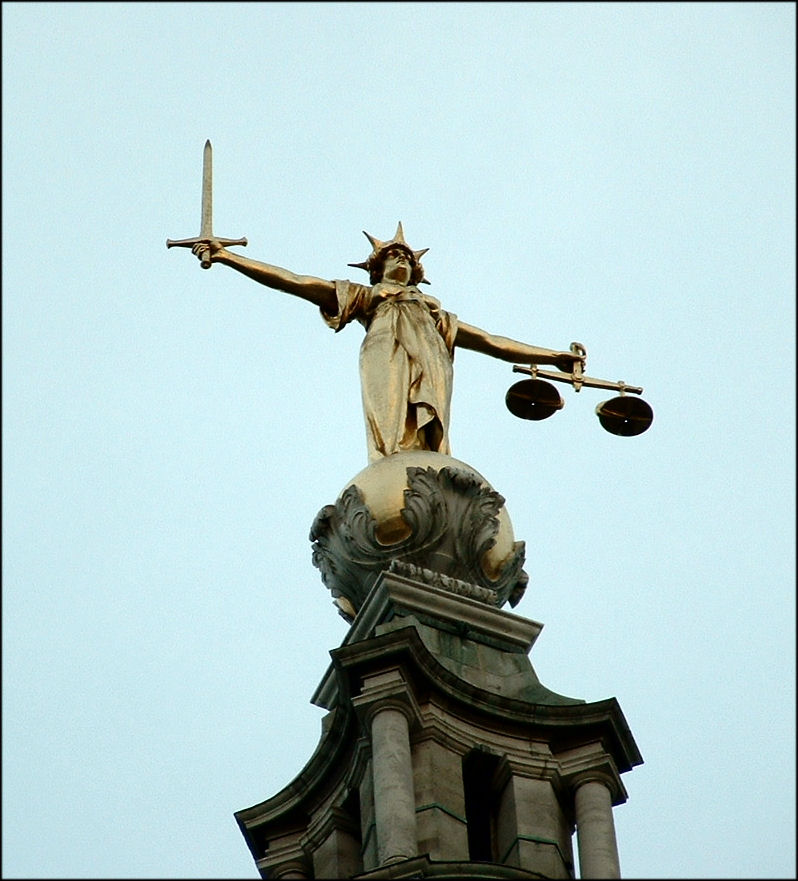
Seers are associated with blindness but so is Justice. The statues picture here are of Justice, which has long been depicted as blindfolded with sword and scales. The first is on top of the Old Bailey, the criminal court in London, the second is outside the supreme court of Canada (it just looks more menacing and mysterious). Yet, so much of Neverwhere there is not justice. It is not fair that Door's family has been murdered; it is not fair that Richard's life is taken away by being a Good Samaritan. Door seems to hesitate every time revenge is suggested as the motivating factor in her quest. She never seems to be trying to mete out justice herself but to see, to understand her unfathomable loss. Sight in Neverwhere becomes a more nuanced thing purchased at great price. Richard and Door can't go back to the way things were they can only come through them to with a clearer vision. It is a much more sophisticated idea than that everything will just be made okay again by an omnipotent source. It is telling that Door, Richard and the Marquis end up back at the black friars who are not there to make everything as it was but to help heal their wounds.