Showing posts with label City of London. Show all posts

Thursday, April 15, 2010

Bits, Bobs, and Oddments

I have been away from the rehearsal process for a bit (working on another play) so I am feeling a bit disconnected. I am looking forward to coming back and witnessing what has happened while I have been gone. In the meantime I am including some bits and pieces, quotes and facts and tidbits from things I have been reading that resonate with Neverwhere.

"If you look at a thing 999 times, you are perfectly safe; if you look at it for the 1000th time, you are in danger of seeing it for the first time." – G. K. Chesterton, The Napoleon of Notting Hill


"But when first the two black dragons sprang out of the fog upon the small clerk, they had merely the effect of all miracles--they changed the universe. He discovered the fact that all romantics know--that adventures happen on dull days, and not on sunny ones." – G. K. Chesterton, The Napoleon of Notting Hill


"He was a genuine natural mystic, one of those who live on the border of fairyland. But he was perhaps the first to realise how often the boundary of fairyland runs through a crowded city." – G. K. Chesterton, The Napoleon of Notting Hill


" Of the thousand millions of human beings that are said to constitute the population of the entire globe, there are -- socially, morally, and perhaps even physically considered -- but two distinct and broadly marked races, viz., the wanderers and the settlers -- the vagabond and the citizen -- the nomadic and the civilized tribes." – Henry Mayhew, London Labour and the London Poor


“The Street-sellers of Mineral Productions and
Curiosities -- as red and white sand, silver sand,
coals, coke, salt, spar ornaments, and shells.

These, so far as my experience goes, exhaust
the whole class of street-sellers, and they appear
to constitute nearly three-fourths of the entire
number of individuals obtaining a subsistence in
the streets of London.

The next class are the Street-Buyers, under
which denomination come the purchasers of hare-
skins, old clothes, old umbrellas, bottles, glass,
broken metal, rags, waste paper, and dripping.

After these we have the Street-Finders, or
those who, as I said before, literally "pick up"
their living in the public thoroughfares. They are
the "pure" pickers, or those who live by gather-
ing dogs'-dung; the cigar-end finders, or " hard-
ups," as they are called, who collect the refuse
pieces of smoked cigars from the gutters, and
having dried them, sell them as tobacco to the
very poor; the dredgermen or coal-finders; the
mud-larks, the bone-grubbers; and the sewer-
hunters.

Under the fourth division, or that of the
Street-Performers, Artists, and Show-
men, are likewise many distinct callings.”

Henry Mayhew, London Labour and the London Poor


“It is not down in any map; true places never are.” – Herman Melville, Moby Dick

A station agent at King’s Cross station said there were two suicide attempts per week – Stephen Smith, Underground London


The closed Angel station was used as a bomb shelter during World War II - Stephen Smith, Underground London


“This author’s endeavour should be to make the Past, the sense of all the dead Londons that have gone to the producing of this child of all the ages, like a constant ground-bass beneath the higher notes of the Present. “ Ford Madox Ford, The Soul of London


The city does not tell its past, but contains it like the lines of a hand.” Italo Calvino, Invisible Cities

Friday, February 26, 2010

Wrong Turns, Back Tracking and Flights of Fancy: A bit more about process


Being a dramturg is in part a really great excuse to buy lots of books without guilt. It also means trying to incorporate and synthesize a whole lot of information in ways that will be meaningful to your fellow artists or an audience. Sometimes this means you let go of some bit of information you love because it isn't useful and sometimes it means you smack your head when you missed something you should have already found.

Last night for example, I got a little book shaped package in the mail that was, in fact, a book, What's in a Name: The origin of the names of all the stations in current use on the London Underground and the Docklands Light Rail with their opening dates. So the title is a bit of a mouthful but the book is full of useful information from Mr. Cyril M. Harris and the London Transport Museum. In it I found some information on Islington that I had entirely missed in the last post and in the OED. (I have gone back and added it now.) However, that is part of any good artistic process (particularly when collaboration is involved) being willing to find something you have missed or let a cherished idea that isn't working go away.

So that confession out of the way, I wanted to give some of the splendid information (from this splendid little book) about some of the stations mentioned in Neverwhere (not all of them of course since this book only covers open stations.)

Angel Islington
Angel station takes its name from the Angel coaching in and dates to at least 1638. The station opened in 1901. Islington comes from either of a couple of Anglo-Saxon words Gislandune meaning Gisel "hostage" and dun "hill" or Isendone which is from isel "lower" and don "a fortified enclosure" so Angel Islingdon would of course be that fortified low place where you might keep an angel hostage.

Blackfriars
Blackfriars refers to the black robes worn by the Dominican monks who had lived in a monastery founded by the Earl of Kent in the 13th Century. The monastery was dissolved (such a delicate way of putting it) by Henry VIII in 1538 but reemerged as a Blackfriars Theatre but was pulled down in 1665. The station opened in 1870.

Earl's Court
After the Norman Conquest the De Vere family was given a manor which also had a court when a later head of the family was made the Earl of Oxford it became Earl's court. The court building was torn down in 1886. The station opened in 1871 but burned in 1875 then was rebuilt and opened again in 1878.

Hammersmith
The origins of Hammersmith or Hammersmyth are some what obscure. The most likely come from the Anglo-Saxon hamor "hammer" and smydde "a smithy" referring to a blacksmith who once lived there. An alternate suggestion is from the Anglo Saxon ham "town" or "home" and hythe "port" The first option seems most likely for Neverwhere given that we meet Hammersmith and he is a smith but there is something of a home port about him for Door as well. The current station opened in 1874 but an earlier one was opened in 1864.

Knightsbridge
Knightsbridge shows up in 1046 as Cnihtebricge meaning "the bridge of young men" but in 1364 it was recorded as Knyghtessbrugg a somewhat dubious suggestion was that knights had jousting tournaments there. There was a bridge however but the stream it crossed is now buried and like many of London's rivers now part of the sewage system. The station opened in 1906

Marble Arch
If the story has the oath "Temple and Arch" I figure I should include the Marble Arch and Temple stations. The Marble Arch was designed by John Nash after the Arch of Constantine in Rome and is made of Italian Marble from Carrara. When it was first raised in 1828 it stood in front of Buckingham palace. It was moved to Hyde Park in 1850-1851. The station opened in 1900.

Seven Sisters
The name referred to the seven elm trees which stood in a circle near Page Green, which may have stood for pagan's green. The station opened in 1986.

Shepherd's Bush
The name may have referred to shepherds who used the green for their sheep or it may have referred to someone named Sheppard as it appeared as Sheppard's Bush Green in 1635. The station was moved and reopened in 1914. (Of course you don't want to meet the Shepherd's here.)

Temple
The land was owned by the religious/military order the Knights Templar in 1118. They derive their name from Solomon's Temple in Jerusalem where they had quarters during the crusades. The Pope dissolved the order in 1312 and the buildings in London started being used for law courts and lawyers in the 14th century. The station opened in 1870.

After all that history the Herman Melville quote popped into my head, "It is not down in any map; true places never are." That may be the biggest problem in trying to chart a course through imaginary places. I just hope to get to the true place eventually.

Friday, December 11, 2009

The Floating Market at Harrods

The night I made my way to check out the location in Harrods famous department store where Hunter is hired to be Door's bodyguard, my camera decided to take some shoddy pictures. Regardless...
I ended up at Knightsbridge, of course.


(Interesting tile work here at Hyde Park Corner, one stop away.)


Harrods was decked out in green not for the holidays (too early for that) but for the 70th anniversary of the movie The Wizard of Oz.


"The Meat and Fish Hall" inspires by name the image of a spacious, cavernous room.  Meeting by the "fish statue" evokes a museum like space, populated by artwork and marble.  Well, it's almost like that.  But with the amount of intense fighting involved, there is just too much in this room! It wouldn't fit an arena - these masters of combat are fighting in cramped, ornate quarters!


The titular fish statue, I believe... the only one I found.


I wanted to hang out at the caviar bar and sip champagne, maybe eventually making my way to the oyster shucker, but I was pressed for time.  So I went next door to the cheese shop, to see if I could find a contest on "silliest walk."


Imagine this scene at night, the perishables put away, and in the aisles a menagerie of stalls, vendors, smells delightful and gutwrenching, crowded with people shoulder to shoulder of all different shapes, sizes, colors, dress, dialects, shouting, pushing, vying for your attention, some looking like they'd pick your pocket, some looking like they'd slit your throat, some looking at you with hungry, cold eyes.

Monday, December 7, 2009

A partial telling of the Story of the London Underground


It should be no surprise that a major part of my visiting London involved a growing fascination with the London Underground.  I tried to catch as many pictures and ogle the tile work of the tube stations I visited as much as possible without blocking pedestrian traffic.  Sadly for me, London Transport officials have stopped allowing public tours of the derelict stations, of which Down Street was high on my wish list.  But I wandered happily around where I could, paid a visit to the richly curated London Transport Museum (where I bought the souvenir you see above) and I recently watched for the last time The Story of London's Underground, the cheesy 2006 doc I've had on loan from Netflix for over a month. The music is annoying and the presentation grainy but the information is fascinating to someone who's a little fanatical about finding bits of history about the London Underground.


In as early as 1800 London was the largest city in the world.  In the early years, horse was the only way to get around and traffic congestion was a huge problem.  A commission started in 1855 looked at the problem of traffic congestion and one of the members of the commission, solicitor Charles Pearson, saw public transport as a way to clear London slums and get the poverty stricken, disease ridden populace into safe, affordable homes.  At the end of the Crimean War, parliament voted public money for a vast network of sewers, fearing the city would not survive without them. Thus begins a new London under ground.  Cholera practically disappeared and London engineers began to lead the world in tunneling. 

The horse driven bus first enabled London to grow outwards but by the 1840's London had grown beyond an hour's ride to the city center. The arrival and development of the steam rail by 1829 didn't solve anything, because the main railways wanted to build their termini as close to the city center as possible. A commission early on decided that railways couldn't build too close to the city center because of the destruction of property that involved. As a result, they came in to a periphery of the city so that people arrived into London by train and immediately wanted to go elsewhere, which meant either by foot or by horse drawn cab.  So the railways brought more and more people to London and actually made the congestion worse. Pearson's idea was to connect the mainline railway stations with a new system, the issue being how to build it when London was so built up. Money was raised and work actually started by cut and cover tunneling - dig a trench, put a railway at the bottom and here and there roof it over so that property could be restored on top.  Today's Maryleborne and Euston roads cover the first section of tunneling.  In many cases they did actually have to purchase property and demolish it. 

Steam was the only viable technology present to propel the trains and they had areas of open tunnels to allow the steam and smoke to escape. A condensing engine was developed to consume its own smoke but it took some revising.  The 1866 engine for the Metropolitan Railway was the most successful first development, used until 1905.  In 1864 the Met started to issue workman's fares - costing less for the skilled working class to move out of the center to Hammersmith, Waterloo.
The system was the first classless public transport with no classification for seating.  


The construction of new suburbs did not take place as rapidly as Pearson envisioned while the slums were being torn down and the central tunneling of the Met didn't really extend outwards as much as envisioned meaning it didn't solve the congestion as much as it was hoped to because the lines circumnavigated the city center.   The concept was okay but clearly the cut and cover record wasn't working and was too expensive.  They needed to find a new engineering method.

Marc Brunel constructed the Thames Tunnel, a 20 year long financial disaster, started off an engineering process of a tunneling shield held back the walls while the tunnel was bricked off.  He succeeded at building the tunnel eventually but his technique, developed by James Henry Greathead and William Henry Barlow, using hydraulics, would erect an iron lining behind the shield advancing the tunnel by 13 feet a day.  The fact that beneath the city was there was a huge bed of clay, made this kind of tunneling possible.


Propelling trains still being a problem that deep under ground, steam powered cable hauling was tried but in 1888 an inventor and engineer named Frank Sprague proved that a number of trains could be run simultaneously by electric motor in Richmond, Virginia. First everything was built too small to make enough money, the first effective tubeline ran from the city out to Shepard's Bush.  Infamous financieer, Charles
Tyson Yerkes arrived in London from Chicago to persuade the Americans to finance a plan to further the underground by 1907, providing electrification and the building of a number of new lines.


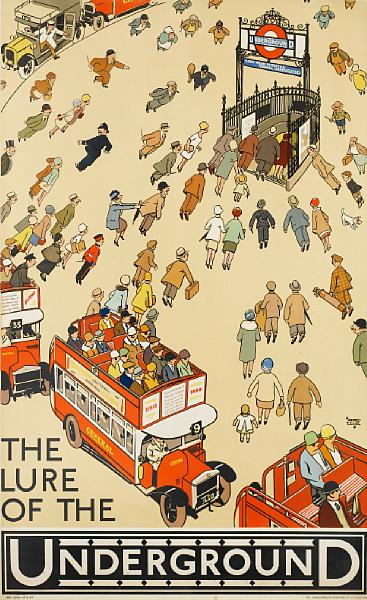
The new system had a distinct marketing problem asking pedestrians to feel that going underground was safe, clean, easily accessible and sensible. Frank Pick lead the charge on developing a bold marketing move across the board. The use of high quality graphic design was established, with new artists and traditional designers creating beautiful poster art advertising the system.  A new typeface was commissioned in 1916 and the Bar and Circle logo was developed. Charles Holden created a functional and marketable design for new stations utilizing the logo design that was also highly functional.  And in 1933, a man named Henry Beck designed a map of the underground system some say revolutionized the way the public perceived the system (though not all agree).


Investors in the development of the underground were also investing in property in the green fields surrounding London, knowing that suburban development would soon follow. "MetroLand" was begun by Metropolitan Railway, given free reign to develop land as they wished, establishing ten huge estate near the railway, encouraging other developers and builders through 1933.  The West End flourished thanks to public transport, what was once an upper class residential area without commercial business development welcomed big department stores, theaters and movie houses, creating a great draw for the public.


World War I saw the first use of the tube as a bomb shelter which returned in World War II.  While some bombs did fall on stations and lines, people by the thousands would bring their families underground and lie there on the platforms through thesuspenseful nights. In 1942 some stations were converted into underground arsenals and munitions factories.  Here's a clip from the doc about that:

Story of The London Underground - Underground Shelter

Of course after I dropped the doc back in the mail I found these clips online that are much better. Oh well.


Saturday, November 21, 2009

Where Old Bailey revives the Marquis de Carabas

I walked along the south bank of the Thames and caught up with the HMS Belfast to check it out before moving on to take a tour of the Tower of London.  I really was curious to see what Old Bailey had to deal with, going to the Floating Market to barter for the body of the ex-marquis and get it to the wall surrounding the Tower to perform a bit of unholy magic and bring him back to life. 

I had the fortune of a gorgeous day, one passing light rain surrounded by sun and blue skies. Imagining the setting at night makes it all even more impressive a view.  First, the HMS Belfast is HUGE. You can hopefully catch some of the scale here by seeing some people on deck from the shore. The HMS Belfast is a retired World War II and Korean War battleship, used now as a museum and occasionally for reenactments.

Nearby Tower Bridge connects me to the north bank where the Tower of London sits, as it has in various forms for almost 1000 years. I took the tour and would so again. The Yeoman Warder who gave our tour was particularly interested in defensive architecture and had an enjoyable enthusiasm for describing the horrid condition of the moat, the tales of prisoners and executions at the Tower, the description of what happened in the dungeons and how some executions up on Tower Hill didn't always go so cleanly.  He set a perfect stage for the macabre scene of the marquis's resurrection. The arches here and gargoyles and original Roman walls and banded doors also provided some juicy inspiration.

I ended with a shot of the wall most accessible to the river and the view of the ship from there just to tie it all back together. Enjoy.

Wednesday, November 11, 2009

Mind the Gap!

Richard, while trotting alongside Door, Hunter and the Marquis de Carabas, looking for Earl's Court, finds himself in the pedestrian tunnel connecting the Monument and Bank tube stations. I had to see this.

That hallway entrance in the center of the picture is on the Westbound platform of the Monument District and Circle lines.  Join me wont you?


And that's about it. Not much to write home about right? Well, that's the thing.  You see Richard go through these intense periods, right before this little trek he had actually been crying thinking he had been abandoned by Door, Hunter and the marquis, and then he finds himself somewhere very familiar and ordinary.  Then something extraordinary happens to him again.


He's heard and seen this phrase hundreds of times and understands the danger implicated. How could it be any more dangerous than what he knows? It is right there in front of him, the same scene he's experienced over and over - the wondering which of the rails is the Really Bad one, the scuttling of small brown mice as they search for remnants of lunches. What in the world could actually be THAT dangerous? A grabby smokey tentacle from another dimension, that's what.

All on his way to


in the quest to meet the


See what I mean? Richard has got to hold on to his sanity in a very real way as he experiences the convolution of all he knows to be true and real and unquestionable.

Frankly, I think we can relate to that. It is a part of the process of living. Richard just gets the quadruple extra large version.

Wednesday, November 4, 2009

Temple and Arch

The architecture of England's oldest and most revered churches are founded on the sanctity of the Temple and the invention of the structural marvel of the Arch.  It is a fascinating choice of Gaiman to use the phrase "Temple and Arch" as an evocation, a prayer, an oath. London Below is dependent on the tunneling technology of the Victorian era but before there were tunnels, the churches of England unified the greater culture of the island.  Roman technology journeyed north in the settlement of early London and the surrounding countryside.  And as the Christian faith was spread through the countryside, heathen temples became churches, the communities were centralized by parishes, church leaders maintained lineage and family records giving even deeper generational connection to the area, and eventually the identity of the township was known by the sound of its church bell. 

Here are two slideshows of pictures of two well known churches.

The first is of St. Paul's (Old Bailey's favorite site), one of the tallest buildings in the City.  It stands as a sentinel, with its iconic dome and central location in the square mile known as the City of London. There is something incredibly gratifying about finding it randomly as you scan the rooftops of London; a landmark that immediately orients you to where you stand, where North, South, East and West is, where to find the Thames, the Tate Modern, the Tower of London. It is also a beautiful site on its own.


This second series was taken on a side trip to Stratford-Upon-Avon. It is of the 13th century church where Shakespeare is allegedly buried, Holy Trinity Church.  While the actual exhibition space of Shakespeare's grave was closed for renovation, I took a myriad of pictures of the mossy gravestones, flora and finials, beautiful and frightening gargoyles, stained glass windows, vaulted ceilings and carved wooden pews. The iconography of angels are everywhere. There's a red winged angel in one of the windows that made me wonder.


Wrapped into the functional brick and tile of the London underground is great reference to the Temples and Arches of England's architectural identity. With timeless characters populating our story, we could make reference to the Temple and Arch of their roots and beliefs somehow. Not to mention Bridges. And Doors. More of those to come...

Meanwhile, let me introduce the illustrious Maren Robinson, our dramturg. She will have many a thing or two more to add here, so I've asked her to feel free to contribute.  She's already sent me some thoughts of greater depth on the relationship of the word Temple to London's identity.  Instead of crudely regurgitating her thoughts, I'll let her speak for herself.

Orme Passage

First things first, as far as I'm concerned, is hitting the actual locations mentioned in the book. By tagging my book and a map I discovered that much of Richard's journey involves the West End and Soho. Curious why this area of London inspired Gaiman so, I thought I'd follow adapter Rob Kauzlaric's advice and visit the highly specified location of Richard's encounter with the Marquis de Carabas, where his first real experience of NEVERWHERE's fantasy starts to get going.


"Richard had taken the Tube to Tottenham Court Road and was now walking west down Oxford Street, holding the piece of paper. Oxford Street was the retail hub of London, and even now the sidewalks were packed with shoppers and tourists…."


Absolutely. My first impression upon stepping up from the Tube station was how many thousands of people were packing the streets. I'm not inexperienced with crowds of people in public - I live not far from Wrigleyville in Chicago. Michigan Ave and the so-called Miracle Mile aren't the least intimidating. This is exponentially different. The streets and sidewalks are narrow and irregular, poking around each other in curves and jots. Buses and cabs, mopeds and brave cyclists slalom around pedestrians who are jostling for purchase. The sidewalk has a tide to it, keep up with the rhythm or move off to the side.

"He turned into Hanway Street. Although he had only taken a few steps from the well-lit bustle of Oxford Street, he might have been in another city: Hanway Street was empty, forsaken; a narrow, dark road, little more than an alleyway, filled with gloomy record shops and closed restaurants, the only light spilling out from the secretive drinking clubs on the upper floors of buildings. He walked along it, feeling apprehensive."


That shift is absolutely correct. Two steps off Oxford onto Hanway, suddenly I feel exposed and alone. There may have been a person here and a couple there but the extremity of solitude after riding the wave of the teeming urban parade is almost shocking.


"He did not remember an Orme Passage… as far as Richard could remember, Hanway Place was a dead end… He had been wrong. There was an Orme Passage…"


Well, I look around. I turn thrice widdershins. No luck. No Orme. Gaiman does write fiction after all.


****************

Here's our main character, regular guy Richard. A bit in a rut. A bit disorganized. Rather average. Lives comfortably enough but has no investment in fashion, style or status. Not much personality to him. His fiance Jessica is trying to groom him but that's her ambition, not his. He goes along with what life presents him, a Taoist undercurrent of going with the flow of life and letting it carry him along. Ho hum.

Then he finds himself picking up a visibly injured homeless girl off the street and carrying her to his flat. Some sense of humanity lies deep under his shabby old sweater and he becomes something, not quite as grand as a Champion of Justice, but suddenly we realize he is a Good Man at Heart, maybe even Brave. Definitely maintaining his impulsive flow-going, he's also sensitive, and the immediate commitment to action to try and "rescue" this young woman feels foolish yet Right. By leaving Jessica and skipping out on their date, despite her enraged threats shouted down the street, Richard makes a choice that no matter how improbable it is that he will benefit from this act, it is something he Must Do.

Thus he approaches the instructions (delivered by a Rat, with help from a Pigeon none-the-less) to meet up with the Marquis on the girl, Door's, behalf, with the same vague sense that despite the improbability of the whole thing, he Must go through with it, maybe even to just test his own resolve. Facing the population of London and wandering around a back alley must feel incredibly stupid and embarrassing, but he goes through with it. Hidden within, like Orme (More?) Passage, he has a hero blooming. Believing deep behind that old shabby sweater that he Must Do Something, for Good, for Balance, for the Right.

And simply because he was asked to. How could he say no?

Friday, October 16, 2009

London


About four months ago I decided A) I need a vacation, B) I should travel somewhere and C) I should go to London.  Many many years ago, when I was in high school, way back before I knew I'd be acting and directing plays, I went with a humanities class for a 10 or 12 day trip.  What I recall of the trip is a cacophony of teenage dramas and the striking images of the touristy highlights - Stonehenge, Bath, Shakespeare's grave, the Tower of London.  What interests me for this go around includes the Must See attractions of London but focuses more on the City and experience of London as the setting of Neil Gaiman's book, NEVERWHERE.

Chicago theater is rather anglophilic.  We love plays about Britain's history. We like savvy upper crust Brit detectives and scurrilous cunning Brit villains.  Dialect geeks live and breathe for the nuanced sounds of the British isles and we've sighed over and over again at the romance of the English countryside.  NEVERWHERE is something a bit different though. As a modern urban fantasy we are drawn into a London that is current, vibrantly chaotic and full of life. The City of London is itself as much a character in the story as anyone else.  Gaiman names characters after streets and tube stations.  We are surrounded by her, steeped in her streets and alleyways, and most importantly, lured underground to explore her mysteries.

I will be touring London Above and London Below for inspiration, clarification, research and just shear geeky pleasure.  I have been digging through my copy of NEVERWHERE and tagging locations in my very own guide to NEVERWHERE's London. Click on any of the blue tags in the map below for a brief description of the area's significance to the story. 


View Neverwhere in a larger map


This map will continue to grow and be edited with further detail, including photos, as I visit them.  This blog will catalog those experiences and their relevance, but will also be a space for any and all pre-production reference, announcements, inspirations and ideas. 

The London we create onstage will be an approximation, but one that I am interested in feeling right - very urban, very current, somehow ancient and modern at the same time.  Starting with the City for inspiration seems like the right way to begin, as this is a London story.