Thursday, April 22, 2010

Dry Tech

I'm currently sitting in the theatre while Assistant Sound Designer Adam Hubbell gets his computer plugged into the sound system from the audience seating. Charlie Alves has his projector set up. Kevin Gawley just told me that 80 - 85% of the lighting fixtures are ready. We're hunkering down for Dry Tech.

Why "Dry"? We are essentially doing a run of the show without actors and without lines, hitting every moment of light, sound and projection transition before we add actors tomorrow night and start Tech rehearsals. It is a Dry Run.

We're getting started almost an hour late - these things happen of course - and it will probably be a late night. But the time we spend on this stuff now will save the actor's from too much sitting around and expedite our process to come.

Wednesday, April 21, 2010

The Floating Market Benefit

Hello all!

Monday evening our theatre company had a benefit themed around the Floating Markets of Neverwhere and don't just take my word for it, the event was an incredible success.  Bleeding Cool contributor Greg Baldino was there and wrote up a cool piece about the event here.  And photographer Lisa Marie Ogle has put some pics up on her Flickr page. I'm the guy in the white tux jacket. :P


Friday, April 16, 2010

Old Bailey: "London shall have all its ancient rights"


The quote above is one of the inscriptions in the Old Bailey the name given to the criminal courts in London and named for the street on which it stands. It is close to Newgate prison.

Old Bailey also makes a cameo in a children’s rhyme, “Oranges and Lemons.” Like many old rhymes there seem to be many variations. I have included one below. When will you pay me feels appropriate for Old Bailey in Neverwhere, although I have also heard the perhaps apocryphal story that it refers to the bells of Old Bailey ringing and being used as a signal for hangings at Newgate prison which lends a darker tone to the concept of “being paid”. Old Bailey is linked closely both to death and to the obscure bartering system that governs London below.

"Oranges and Lemons" say the bells of St. Clements.
"You owe me five farthings" say the bells of St. Martins.
"When will you pay me" say the bells of Old Bailey.
"When I grow rich" say the bells of Shoreditch.
"When will that be" say the bells of Stepney.
"I do not know" says the great Bell of Bow.

Old Bailey is also the court in A Tale of Two Cities. Old Bailey in Neverwhere is certainly a Dickensian creation. Unlike the other denizens of London Below he is a self-proclaimed “roof-man” and a costermonger branching out in his business from birds to information. Like a lot of characters in Dickens he is likeable but one suspects he is often be on the wrong side of the law if the law is anything he stops to consider. He occupies the other neglected spaces of London - the rooftops.


In looking for images of the Old Bailey I stumbled across this website, which is part of an effort to put cases from the Old Bailey between 1647-1913 on line. It is not particularly relevant to Neverwhere but it was so interesting I felt I should add the link.

Thursday, April 15, 2010

Bits, Bobs, and Oddments

I have been away from the rehearsal process for a bit (working on another play) so I am feeling a bit disconnected. I am looking forward to coming back and witnessing what has happened while I have been gone. In the meantime I am including some bits and pieces, quotes and facts and tidbits from things I have been reading that resonate with Neverwhere.

"If you look at a thing 999 times, you are perfectly safe; if you look at it for the 1000th time, you are in danger of seeing it for the first time." – G. K. Chesterton, The Napoleon of Notting Hill


"But when first the two black dragons sprang out of the fog upon the small clerk, they had merely the effect of all miracles--they changed the universe. He discovered the fact that all romantics know--that adventures happen on dull days, and not on sunny ones." – G. K. Chesterton, The Napoleon of Notting Hill


"He was a genuine natural mystic, one of those who live on the border of fairyland. But he was perhaps the first to realise how often the boundary of fairyland runs through a crowded city." – G. K. Chesterton, The Napoleon of Notting Hill


" Of the thousand millions of human beings that are said to constitute the population of the entire globe, there are -- socially, morally, and perhaps even physically considered -- but two distinct and broadly marked races, viz., the wanderers and the settlers -- the vagabond and the citizen -- the nomadic and the civilized tribes." – Henry Mayhew, London Labour and the London Poor


“The Street-sellers of Mineral Productions and
Curiosities -- as red and white sand, silver sand,
coals, coke, salt, spar ornaments, and shells.

These, so far as my experience goes, exhaust
the whole class of street-sellers, and they appear
to constitute nearly three-fourths of the entire
number of individuals obtaining a subsistence in
the streets of London.

The next class are the Street-Buyers, under
which denomination come the purchasers of hare-
skins, old clothes, old umbrellas, bottles, glass,
broken metal, rags, waste paper, and dripping.

After these we have the Street-Finders, or
those who, as I said before, literally "pick up"
their living in the public thoroughfares. They are
the "pure" pickers, or those who live by gather-
ing dogs'-dung; the cigar-end finders, or " hard-
ups," as they are called, who collect the refuse
pieces of smoked cigars from the gutters, and
having dried them, sell them as tobacco to the
very poor; the dredgermen or coal-finders; the
mud-larks, the bone-grubbers; and the sewer-
hunters.

Under the fourth division, or that of the
Street-Performers, Artists, and Show-
men, are likewise many distinct callings.”

Henry Mayhew, London Labour and the London Poor


“It is not down in any map; true places never are.” – Herman Melville, Moby Dick

A station agent at King’s Cross station said there were two suicide attempts per week – Stephen Smith, Underground London


The closed Angel station was used as a bomb shelter during World War II - Stephen Smith, Underground London


“This author’s endeavour should be to make the Past, the sense of all the dead Londons that have gone to the producing of this child of all the ages, like a constant ground-bass beneath the higher notes of the Present. “ Ford Madox Ford, The Soul of London


The city does not tell its past, but contains it like the lines of a hand.” Italo Calvino, Invisible Cities

Monday, April 12, 2010

Oh, the Places You'll Go!


Tonight begins the first time we rehearse on the nearly completed set, constructed in wood and metal in four hundred or so square feet of stage.  We've been rehearsing in a bare room upstairs at Lifeline Theatre's space since early March, imagining various platforms, ladders, doors and stairs, we've experimented with movement through different entrances and exits to help us tell the trajectory of the story from London Above to London Below and back again.  We've fidgeted with the script, tweaking here and there or asking Rob to rethink whole passages.  We've speculated on what props need to be tracked onstage and off, how we deal with them, which of the characters my nine actors are channeling in each scene, how they use their bodies and focus to create the environments we need and I've pondered much about how lights and sound and projections will help us get where we need to be.  We've choreographed the fights, including the epic battle with the massive Beast of London.  We've tried to time and foresee how all of this movement will work once we get on the set.  And now we get to find out.


It's an incredibly exciting moment. We've been peeking in downstairs every now and then to watch the progress as scenic pieces are being built.  We all have had our oohs and ahhs over parts of it and we also have had our fears  - about how a clumsy step on a high platform could spell disaster, or how a whip quick costume change could affect a timely entrance on the other side of the stage.  No doubt about it, this is another part of the process calling for brave hearts and flexible thinking.  I assume I understood the way the space will work for us, but that vision will be tested this week.  


Last night I met with members of our technological design team on lights, sound and projections for five hours to talk through the script from start to finish and decide what we want to happen when.  The meeting for this is called a Paper Tech in that we technically work out on paper the results of our conversations.  (In an interesting turn of technology we had four Mac laptops plugged in, our lighting designer Skyped in to attend from where he was in Wisconsin, and yet still all of us had pencils and erasers and paper in hand - it does not appear that Paper Tech will change to "Laptop Tech" any time soon.) We talk about how long a transition should feel like, what it might sound like, how our various arts can combine to help tell the story, tell the story, tell the story.  We tie the cues for these lights and sounds to specific actions the actor's have created in rehearsal or we tie them to a specific line - even down to a word.  So gestures, words and movement cue the stage manager to drive the tech.  Now my designers, encouraged and empowered by our meeting, will have almost two weeks to build their contributions in preparation for our actual technical rehearsals, the next big leap in our process when we put all of that theory into practice.

Sunday, April 4, 2010

First Run Through: Fragile Things, Magic and Darkness

I was having one of those late-night-into-early-morning bouts of insomnia. Where a single worry or two seem to invite another and another and they, in turn, are acquaintances of some of my old fears and a few old embarrassing moments and so they come along too “to relive old times” and finally the party is in full swing and it is four in the morning. So I gave up trying to sleep and decided to wait for the sleepy comfort of dawn. The cats were perplexed by the change in routine but were willing to sit next to me on the couch and wait for breakfast while I typed.

I turned to thinking about the first run through I saw on Monday. It is part of a sacred trust as a collaborator with other artists on a play not to reveal the first rough steps of a production. An audience must wait to see a polished gem not a bumpy rock. (Which is not to say that this rehearsal was that bumpy; I thought it was in rather good shape.) I can however reflect on the process though not the details of it. A first rehearsal is a delicate creature. I have heard other dramaturgs refer to their role on a production as midwife to a play and I have never been sure I agreed with the analogy. However, a play newly on its feet (which is often what we refer to the process as getting a play on its feet) is very much like a newborn creature, full of wrinkles and fits and starts as it struggles to stand up. Newborn creatures are not generally lovely right away. But like other newborn creatures it inspires a protectiveness to guard and help until it can stand on its own and defend itself as best it can.

If you are not a participant in theater, then you should appreciate the job the actors have to do at a first run through of a play. They are remembering new blocking, and lines, thinking about the development of their characters, working on dialects and fight choreography all while still working in an empty room with tape on the floor to indicate doors, or steps or ladders. Often this is after putting aside the concerns of a day job and fueled by caffeine while fighting a cold.

Designers come to a first run through and do not generally make a good audience. Not because they don’t enjoy the play but because they are thinking about their various tasks and may have heads bent over notepads or laptops writing questions about a sound cue or how a set piece might function or some costume change that might be needed, or could some story arc be made more clear.

The Marquis de Carabas tells the stranded Richard,You’ll just have to make the best of it down here in the sewers and the magic and the dark.” The act of making theater, the contract between an audience and actors who agree to sit in a dark room and share an experience that is meant to move them is source of continual fascination to me no matter how long I work in theater.

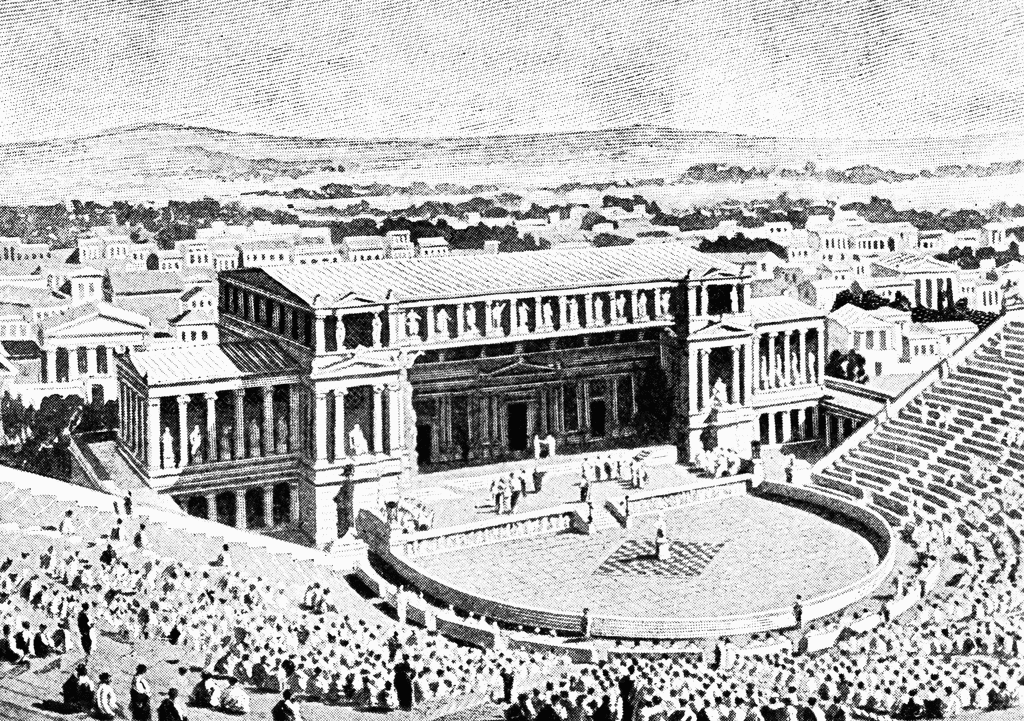
It is no surprise then that the earliest acts of theater are associated with religious rituals. One can imagine the day a hunter at night by a fire told the story of the hunt and the moment another person took up the skin of a gazelle and pretended to be the creature hunted. It is easy to see how the recreation of a fierce hunt for those who didn’t see it but are about to enjoy the meal might become a mystical play. Early Greek theater was part of religious festivals and a shared communal experience. So even though theaters today are not generally tied to religious practice and they often struggle for their financial existence in a world of many competing entertainment voices; there are still those struggling to create fragile things and delicate creatures and there is still something that draws audiences to share the magic and the dark.


Monday, March 29, 2010

Down and Out in Earl's Court


The earl in Neverwhere is nameless. He is so old his person and title are synonymous. The noun earl was used to distinguish nobility from those who weren’t noble, the churls. The word first appears in Beowulf as “eorla,” which here generally means a brave knight or warrior. The King Hrothgar is sitting amidst them. The earl of Earl’s court has something of the Anglo-Saxon about him. His elderly man at arms is Dagvard- his name from the Anglo-Saxon means Dag or day and vard or guard or day-guard. The other man at arms is Halvard and the meaning of the name is a bit more opaque to me. It feels like he should be either the hall guard or the night guard but hal is associated with rocks and sloping hills in my Anglo-Saxon dictionary. (Ah yes, I still have my Anglo-Saxon dictionary from a time when I thought I might be a scholar of this sort of thing so moving it from city to city and apartment to apartment has finally proved worthwhile.) Thus it is also significant that the poetry quoted in the Earl’s court is in the Anglo-Saxon mode which uses alliteration, “Brave the battling blade, flashes the furious fire . . .”

Just to speed through a little bit of English history. The early Celtic inhabitants (who themselves may have immigrated to the Island country) have been continually overrun by other people who thought it looked like a nice little green island for pillaging or possibly settling down and building a summer home. The Angles, the Saxon and the Jutes (from Jutland which refers to Denmark) are all early Viking tribes from the areas that are modern Scandinavia that over a long period of time invaded, settled then were invaded upon by other early Viking tribes who either forgot or didn’t care that these were some early cousins. The name England is derived from Angle-land. (There were others who have thought it was a nice little island the Romans and French prominent among them.) Stephen Smith in his book, Underground London, describes a Anglo-Saxon cross found underneath All Hallows that is carved with the word "Werhere" which he says Peter Ackroyd has said strongly suggests, "we are here."

There is another charming nod to this history sitting on the train platform where the Earl’s train court arrives. The beggar Lear is sitting on the platform. King Lear is based on the legend of an early Celtic king. In Shakespeare’s King Lear, the foolish king divides his kingdom and loses his power, his mind, and his daughters. Of course Lear in Shakespeare does not live but his Neverwhere namesake sits begging outside the court of a later ruler.

There is a fool in King Lear (apart from Lear) who is known only as the Fool. In Earl’s court there is a fool named Tooley. Tooley is a London street in Southwark. It is apparently a corruption of St. Olave’s church, St. Olave or Olaf being the patron saint of Norway. It was apparently the home of many wealthy citizens in the Middle Ages. Since it was close to the docks it was for a time known as “London’s Larder” It is now home to the campy London Dungeon which features actor recreations of gory bits of London history. Tooley Street was also the location of a cheap boarding house where writer George Orwell lived played the part of a beggar while he researched social conditions for his 1933 book Down and Out in Paris and London.

Richard is able to imagine the earl as he was when he was “a mighty warrior, a cunning strategist, a great lover of women, a fine friend, and a terrifying foe.” The earl’s court has undergone a similar decline to Tooley Street and similar to the end of Beowulf. (I have linked to the Gummere translation but if you get a chance read the Seamus Heaney translation.)In reading it again, was reminded of one of the final episodes of Beowulf in which the aging king Beowulf goes out to face a dragon with a young hero. There is a sense of decline in that the old King can no longer protect his people but the young hero, Wiglaf, is not up to the task and will not be the leader that Beowulf was. Together they slay the dragon but Beowulf dies of his wounds and lives only in the after-singing.

The earl is the one who assumes Door is out for vengeance he is also getting old and his memory is muddled. Hunter calls the earl’s real domain “Things lost. Things forgotten.” He has collected not only the lost detritus of London above compressed in London below but fragments of history and old alliances and knowledge of Islington which enables him to help Door.

A side note for those who are getting tired of obscure footnotes. I am looking forward to watching the first run through of the play tonight. All this research is fun but it will be nice to see the story "on its feet.."