Sunday, April 4, 2010

First Run Through: Fragile Things, Magic and Darkness

I was having one of those late-night-into-early-morning bouts of insomnia. Where a single worry or two seem to invite another and another and they, in turn, are acquaintances of some of my old fears and a few old embarrassing moments and so they come along too “to relive old times” and finally the party is in full swing and it is four in the morning. So I gave up trying to sleep and decided to wait for the sleepy comfort of dawn. The cats were perplexed by the change in routine but were willing to sit next to me on the couch and wait for breakfast while I typed.

I turned to thinking about the first run through I saw on Monday. It is part of a sacred trust as a collaborator with other artists on a play not to reveal the first rough steps of a production. An audience must wait to see a polished gem not a bumpy rock. (Which is not to say that this rehearsal was that bumpy; I thought it was in rather good shape.) I can however reflect on the process though not the details of it. A first rehearsal is a delicate creature. I have heard other dramaturgs refer to their role on a production as midwife to a play and I have never been sure I agreed with the analogy. However, a play newly on its feet (which is often what we refer to the process as getting a play on its feet) is very much like a newborn creature, full of wrinkles and fits and starts as it struggles to stand up. Newborn creatures are not generally lovely right away. But like other newborn creatures it inspires a protectiveness to guard and help until it can stand on its own and defend itself as best it can.

If you are not a participant in theater, then you should appreciate the job the actors have to do at a first run through of a play. They are remembering new blocking, and lines, thinking about the development of their characters, working on dialects and fight choreography all while still working in an empty room with tape on the floor to indicate doors, or steps or ladders. Often this is after putting aside the concerns of a day job and fueled by caffeine while fighting a cold.

Designers come to a first run through and do not generally make a good audience. Not because they don’t enjoy the play but because they are thinking about their various tasks and may have heads bent over notepads or laptops writing questions about a sound cue or how a set piece might function or some costume change that might be needed, or could some story arc be made more clear.

The Marquis de Carabas tells the stranded Richard, “You’ll just have to make the best of it down here in the sewers and the magic and the dark.” The act of making theater, the contract between an audience and actors who agree to sit in a dark room and share an experience that is meant to move them is source of continual fascination to me no matter how long I work in theater.

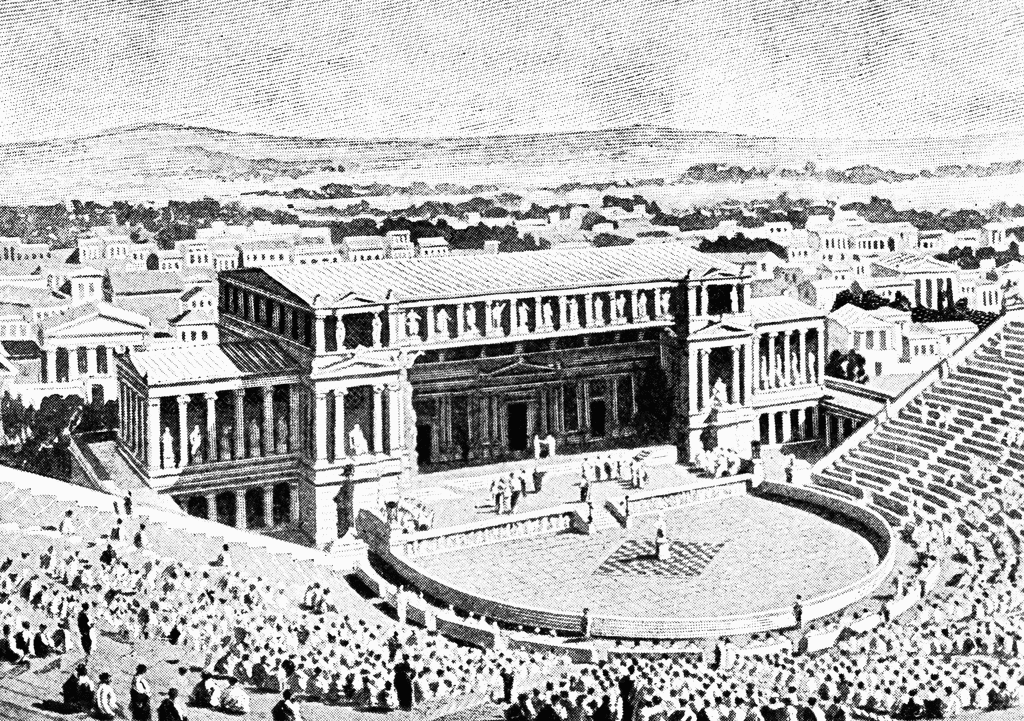
It is no surprise then that the earliest acts of theater are associated with religious rituals. One can imagine the day a hunter at night by a fire told the story of the hunt and the moment another person took up the skin of a gazelle and pretended to be the creature hunted. It is easy to see how the recreation of a fierce hunt for those who didn’t see it but are about to enjoy the meal might become a mystical play. Early Greek theater was part of religious festivals and a shared communal experience. So even though theaters today are not generally tied to religious practice and they often struggle for their financial existence in a world of many competing entertainment voices; there are still those struggling to create fragile things and delicate creatures and there is still something that draws audiences to share the magic and the dark.


Monday, March 29, 2010

Down and Out in Earl's Court


The earl in Neverwhere is nameless. He is so old his person and title are synonymous. The noun earl was used to distinguish nobility from those who weren’t noble, the churls. The word first appears in Beowulf as “eorla,” which here generally means a brave knight or warrior. The King Hrothgar is sitting amidst them. The earl of Earl’s court has something of the Anglo-Saxon about him. His elderly man at arms is Dagvard- his name from the Anglo-Saxon means Dag or day and vard or guard or day-guard. The other man at arms is Halvard and the meaning of the name is a bit more opaque to me. It feels like he should be either the hall guard or the night guard but hal is associated with rocks and sloping hills in my Anglo-Saxon dictionary. (Ah yes, I still have my Anglo-Saxon dictionary from a time when I thought I might be a scholar of this sort of thing so moving it from city to city and apartment to apartment has finally proved worthwhile.) Thus it is also significant that the poetry quoted in the Earl’s court is in the Anglo-Saxon mode which uses alliteration, “Brave the battling blade, flashes the furious fire . . .”

Just to speed through a little bit of English history. The early Celtic inhabitants (who themselves may have immigrated to the Island country) have been continually overrun by other people who thought it looked like a nice little green island for pillaging or possibly settling down and building a summer home. The Angles, the Saxon and the Jutes (from Jutland which refers to Denmark) are all early Viking tribes from the areas that are modern Scandinavia that over a long period of time invaded, settled then were invaded upon by other early Viking tribes who either forgot or didn’t care that these were some early cousins. The name England is derived from Angle-land. (There were others who have thought it was a nice little island the Romans and French prominent among them.) Stephen Smith in his book, Underground London, describes a Anglo-Saxon cross found underneath All Hallows that is carved with the word "Werhere" which he says Peter Ackroyd has said strongly suggests, "we are here."

There is another charming nod to this history sitting on the train platform where the Earl’s train court arrives. The beggar Lear is sitting on the platform. King Lear is based on the legend of an early Celtic king. In Shakespeare’s King Lear, the foolish king divides his kingdom and loses his power, his mind, and his daughters. Of course Lear in Shakespeare does not live but his Neverwhere namesake sits begging outside the court of a later ruler.

There is a fool in King Lear (apart from Lear) who is known only as the Fool. In Earl’s court there is a fool named Tooley. Tooley is a London street in Southwark. It is apparently a corruption of St. Olave’s church, St. Olave or Olaf being the patron saint of Norway. It was apparently the home of many wealthy citizens in the Middle Ages. Since it was close to the docks it was for a time known as “London’s Larder” It is now home to the campy London Dungeon which features actor recreations of gory bits of London history. Tooley Street was also the location of a cheap boarding house where writer George Orwell lived played the part of a beggar while he researched social conditions for his 1933 book Down and Out in Paris and London.

Richard is able to imagine the earl as he was when he was “a mighty warrior, a cunning strategist, a great lover of women, a fine friend, and a terrifying foe.” The earl’s court has undergone a similar decline to Tooley Street and similar to the end of Beowulf. (I have linked to the Gummere translation but if you get a chance read the Seamus Heaney translation.)In reading it again, was reminded of one of the final episodes of Beowulf in which the aging king Beowulf goes out to face a dragon with a young hero. There is a sense of decline in that the old King can no longer protect his people but the young hero, Wiglaf, is not up to the task and will not be the leader that Beowulf was. Together they slay the dragon but Beowulf dies of his wounds and lives only in the after-singing.

The earl is the one who assumes Door is out for vengeance he is also getting old and his memory is muddled. Hunter calls the earl’s real domain “Things lost. Things forgotten.” He has collected not only the lost detritus of London above compressed in London below but fragments of history and old alliances and knowledge of Islington which enables him to help Door.

A side note for those who are getting tired of obscure footnotes. I am looking forward to watching the first run through of the play tonight. All this research is fun but it will be nice to see the story "on its feet.."


Sunday, March 28, 2010

First Weeks

We are now out of the theoretical and in practical research mode, testing staging theories on an approximation of the set and figuring out the way we are going to tell our story.   I say "we" because the process, for this director at least, is about collaboration. I can't imagine doing this alone, the show will be that much richer for the contributions of all involved.


There is a sense of enthusiasm that continues to develop as we get into the scene work and discuss characters and as we stage this sucker.  Rob has had to cut much, but he tried very hard to keep in as much of the dialogue from the book he could, often rearranging some small bits here and there to emphasize thematically the growing trust, honesty, and heights of courage and speak to the heart of what is in the book.  And the entire cast is on to it.  


We came across a particularly tricky page or so in the script where Richard is in a variety of different locales trying to get to work and No One notices or recognizes him.  The morning after Door leaves, Richard is running late for work and the people on the street almost knock him down by bumping into him. Gary and Sylvia at the office look at him like they never met him before. His desk and things are gone. Jessica doesn't recognize him. His apartment is being shown to a potential new renter. And the phone stops responding. Then Croup and Vandemar show up, and they are not happy.


This all takes place in about a minute. There is no way I could imagine staging this without the cast in the room, just for the sake of seeing the bodies move in the space. On top of this physical necessity though, many of the cast members are directors and fight choreographers themselves and frankly there is no end to the feeding we get off of each other when we try and sort out a problem. This sequence took input from most of us to figure out. 


This is such an incredibly rewarding way to begin a process - collaboration and enthusiasm will go a long way for us in rehearsal and make the run for the actors that much more enjoyable. Everyone is getting along great, thinking and chattering and joking and figuring it out together.


It is hard to judge what to blog about or share at this point.  We've blocked the play. We are performing the entire play from start to finish for the first time tomorrow night. The fight with the Beast of London, which we haven't had the pieces in place to play with before, comes Wednesday.  To tell you about specifics or show you video of some of the combat we've choreographed would be showing too much - we want you to come see the show LIVE and not know what's coming in advance!  Just trust me - I've collected some of the best minds and voices in Chicago theatre to this project, and we're going to show you something incredibly special.

Sunday, March 21, 2010

London Above: Blindness and Sight


I have been thinking about the characters we see in London above that are from London Above: Jessica, Gary, Sylvia and Mr. Stockton. The new renters or Richard's flat. Almost every moment we see in the world of London above is associated with business or status. Richard works in the financial industry as do Gary and Sylvia and the descriptions of his actual work are coded in the jargon of the industry so as to be as obtuse as the hieroglyphics. Anaesthesia asks him "what's an investment an-thing." He is plunged into a world of bartering, favors and strange alliances where his matches and used hankie take on a new value but his credit card is worthless.
Perhaps it is because I have been dipping into Henry Mayhew's London Labour and the London Poor, but it feels very deliberate that the world of London above is tied to money and status. Richard discovers in London Below that his whole life had prepared him to be an investment analyst but it hadn't prepared him to survive particularly well in London Below. Actual survival skills have ceased to be necessary in London Above and it is highly abstract work with an ambiguous monetary system that allows Richard to have a London apartment and a girlfriend who thinks she can make him into the correct marriage prospect.

Jessica and Mr. Stockton are not in finance but they are in a world peopled almost entirely with the wealthy and famous, who behave appallingly at the opening or "Angels of England."

In 1956, anthropologist, Horace Miner, famously published The Body Ritual of the Nacirema. In which he wrote up descriptions of modern Americans as an anthropologist studying a foreign tribe. Nacirema is American spelled backwards. It now seems to be a popular article to pull out in high school sociology or history classes to make students look at the common practices of a society with fresh eyes. This is what Richard has to do when plunged into London below.

It is telling that in the ordeal it is the faces of Jessica and Gary that come back to him, the faces of what his normal live and goals and values have been. Richard must struggle to hang onto a sense of self that is separate from what failure leading to suicide would be in London Above.


This does not mean that the characters in London below are idealized. They are often selfish, unscrupulous and dangerous but their traits are much more readily identifiable than in London Above. I actually have some sympathy for Jessica and Gary. Jessica is terribly hurt that Richard had changed and doesn't understand it. Gary thinks that Richard may be going off the deep end when he is back and still not satisfied. They both don't have the painfully won self-knowledge that Richard has gained. Jessica is not evil she is self-involved, fairly callous to the homeless but she is operating with in perfectly acceptable standards for success within her society. The same is true of Gary. He is unseeing and perfectly content in his world of work, pubs and women. Thus the refrain from London above is that above-worlders don't see anything.
This leads me to two other characters. The first is the old woman who tells Richard's fortune at the beginning; she first thinks he is homeless because she has been homeless herself. She tells him to beware of doors and that his good heart might be enough to see him through. She is the proverbial seer who links London Above and London Below and links Richard to his future but in the classic fashion of Seers, Richard fails to understand her.

The second is the abbot of the black friars who is blind. "The abbot regarded his own blindness neither as a blessing nor as a curse: it simply was. . ." But in the abbot's darkness he knows another pilgrim is going to arrive and attempt the ordeal. He has a measure of foresight but his sin is waiting because he knows a pilgrim is coming and he ceases to live in the present. However, the abbot does not anticipate how Richard will survive the ordeal.

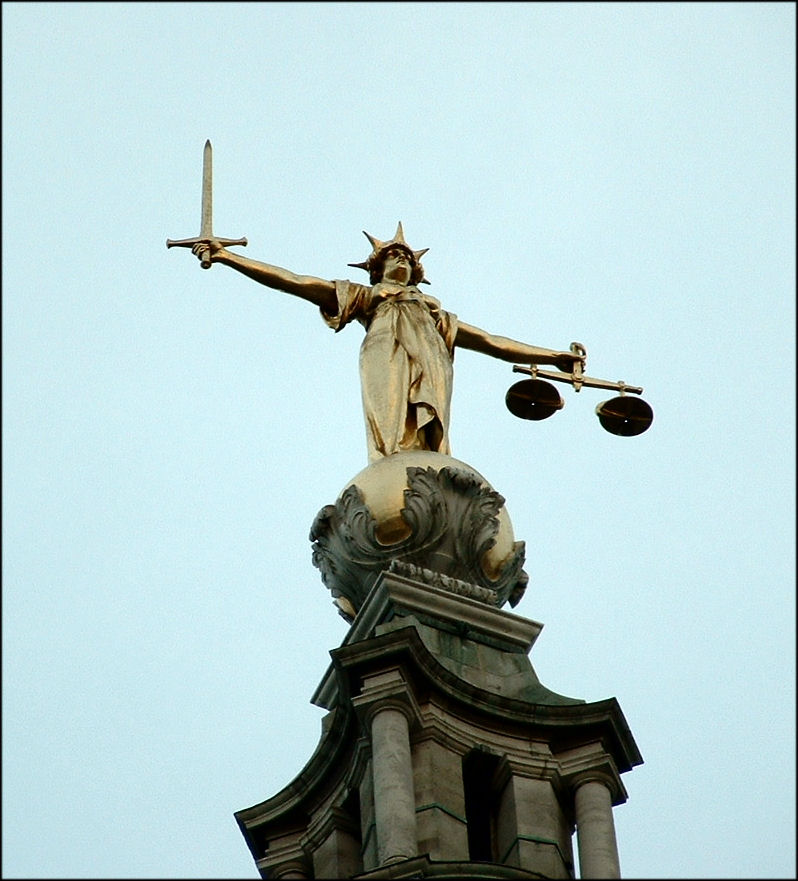
Seers are associated with blindness but so is Justice. The statues picture here are of Justice, which has long been depicted as blindfolded with sword and scales. The first is on top of the Old Bailey, the criminal court in London, the second is outside the supreme court of Canada (it just looks more menacing and mysterious). Yet, so much of Neverwhere there is not justice. It is not fair that Door's family has been murdered; it is not fair that Richard's life is taken away by being a Good Samaritan. Door seems to hesitate every time revenge is suggested as the motivating factor in her quest. She never seems to be trying to mete out justice herself but to see, to understand her unfathomable loss. Sight in Neverwhere becomes a more nuanced thing purchased at great price. Richard and Door can't go back to the way things were they can only come through them to with a clearer vision. It is a much more sophisticated idea than that everything will just be made okay again by an omnipotent source. It is telling that Door, Richard and the Marquis end up back at the black friars who are not there to make everything as it was but to help heal their wounds.


Thursday, March 18, 2010

New article on another site

The comic book industry news website "Bleeding Cool" just posted about Neverwhere, with some quotes from Rob and I about the show and a cool picture. Enjoy!

Wednesday, March 17, 2010

Croup and Vandemar (and Freud - yes that Freud)

"Croup and Vandemar, the Old Firm. Nuisances eliminated, obstacles obliterated, bothersome limbs removed, and tutelary dentistry."

I have struggled with writing about Croup and Vandemar, so I have put it off. They are so specific and at the same time deeply ambiguous. It was delightful to hear our actors Croup and Vandemar at the first read through of the script and I suspect it is a delight for the actors who play them to have the comedic payoff of the Croup's circumlocutions followed by Vandemar's bluntness. Yet, I find the idea of the characters (not the actors) deeply disturbing.

First, to focus on the names. Gaiman has said that Croup and Vandemar are what they call themselves and no one would dare call them anything else. The word croup in the Oxford English Dictionary is defined as the hindquarters of a horse or other beast of burden and also as a disease fatal to children of inflammation to the larynx and cough, or the short form of a croupier or card shuffler. None of which is inappropriate for Croup but none of which captures his menacing loquacity.

Vandemar, is a Dutch name van meaning of de the. I did not find any specific Dutch translation for Mar as either a region or of the sea. However, on its own to mar can mean to hamper, hinder, damage or impair which sounds about like one of Croup's lists of their favorite activities.

There is a history of appealing villains. Iago in Othello, Edmund in King Lear, Count Fosco in The Woman in White. But none of them compare to the menace of the pair of Croup and Vandemar and I think that is because they are all at least human. Croup and Vandemar are not human. They move with great speed and apparent ease, when Croup asks, quoting The Merchant of Venice, "If you prick us do we not bleed." Vandemar answers, "No" Vandemar puts a knife through his hand without feeling any apparent pain or bleeding. When Richard calls them men, Door scoffs then says, "I suppose you could call them men." She then refines her definition of their being men as has having two arms, two legs and a head a piece.

Part of what makes Croup and Vandemar so uncomfortable, so uncanny, is the fact that they have the appearance of the human but are, in fact something other that seeks only destruction. Sigmund Freud has an essay on The Uncanny (which is very accessible - it is as much literary criticism as psychoanalysis) in which he talks about E.T.A. Hoffman's fairy tales and the uncanny. He specifically addresses the idea of the double first in the idea of the body and soul which allows one to think about the immortality of some part of the self in response to fears about mortality but then mentions that its reverse can be seen as a harbinger of death. In Neverwhere, Croup and Vandemar are uncanny because they represent a double or a doppleganger. They have the appearance of men but are not human. These apparently immortal humanlike creatures bring death with them. An outraged Croup lists their credentials to their mysterious employer as having assassinated, kings, popes, heroes and reputed gods as well as starting a plague. Their uncanniness is heightened by their powers seeming to be magical and beyond human. Not only do they bring death but also the can not be stopped by normal human means.

They are disturbing precisely because they seem human and are not and because their power to harm or bring death seems unstoppable. They are also disturbing in the way they function as a pair. They seem almost to know each other's thoughts. At the beginning of the novel Gaiman gives us a long description of how we can tell Croup and Vandemar apart and then tells us they look nothing like each other. Yet that description is necessary because the two beings function together. When Door has opened the door at the end of the novel Vandemar shrugs when he sees Croup sucked in without out him and then lets go to join his partner. The two of them seem to need to be together to function. Oh and for all the Gaiman fans, if you decide to read the Freud there is an interesting discussion of Hoffman's Sand-man.

I also wanted to mention something that has always struck me about Croup and Vandemar's crucifixion of the Marquis. As it is described, the Marquis is not on a cross but on a circle. His arms and legs are out in a gruesome parody of Leonardo daVinci's drawing "The Vitruvian Man" above. It always struck me that this is the height of what Croup and Vandemar stand for. It is not just the loss of life (which would be enough to horrify) but the destruction of beauty, thought, art, every good humanist ideal that we could associate with Leonardo daVinci's renaissance world. It is why Croup's eating a one of a kind piece of T'ang Dynasty pottery fits with the destruction of human life. It is not just an erasing of life but of all human potential and capacity for goodness and beauty.

Perhaps most disturbing of all is their ability to as it is put in Hamlet, "That one may smile, and smile, and be a villain."Although perhaps that refers to Islington since Croup's smile is described as ghastly.

To all Out of Illinois State Gaiman fans:

Interested in coming to see the play, but you're from out of town?

Spend the night downtown at the luxury Hotel Allegro Chicago, a Kimpton Hotel. 

Lifeline Theatre has negotiated a special $109 rate (Thu-Sun, some blackout dates apply) for anyone who buys tickets to Neverwhere.  

Availability is limited! 

Call the Lifeline box office today at 773-761-4477 for details.