Thursday, March 4, 2010

VOLUNTEERS NEEDED! Enter the Floating Market...

Lifeline Theatre is seeking volunteers to work at our 2010 Annual Benefit: Neil Gaiman’s Floating Market on April 19, 2010 the Chicago Cultural Center. We are recreating the Floating Market as conceived by Neil Gaiman is his bestselling book, Neverwhere. There will be food, drink, belly dancers, fire dancers, a wheel of destiny, fortune tellers, and musicians playing found instruments.

We are looking for technical people to help with set-up and break-down and performers to work the event.

Technical: Set up will run from 1:30–6:30pm and will encompass load in and set up of the market. Break down will run from 10:00–11:30pm and will encompass break down and load out at the Cultural Center. All set-up and break-down volunteers will be able to attend the Benefit free of charge.

Performers: Performers will be required from 5:30–10:00pm. You must dress up as a character from the Neverwhere world (e.g. Rat Speakers, Velvets, Sewer Folk, Salvation Army Restoration fops, Junk Yard warriors, etc) and work an assigned area (silent auction tables, entertainment areas, roaming) in character and interact with patrons. We will provide guidelines but you will be responsible for creating your own costume. Performers will be given one complimentary ticket to Lifeline’s production of Neverwhere.

There will be a mandatory meeting for all volunteers on Sunday, April 18th at 3:00 PM.

All inquiries about this opportunity should be sent to allison@lifelinetheatre.com. Please indicate how you would like to help out. First come, first served. Spots are limited. 


Sewerfolk, Ratspeakers, Anesthesia and a Load of Tosh

I have been reading an illuminating book by Stephen Smith called Underground London: Travels Beneath the City Streets. In it, the author investigates a variety places and histories that took place beneath the streets of London. I am in the chapter on the rivers/sewers, which seem to have been the same for much of London’s history. Many of the small rivers that were once open and flowing were covered over at various points in London’s history. Fleet street was actually the location of the Fleet River, which was slowly covered over, a process completed by the 1800s. Its fragrance had been a source of complaints since the Middle Ages and covering the river converted what was already a sewer to an underground sewer.

Apparently the gases created by the sewage built up and 1846 part of Fleet Street blew up and sewage flowed in the streets. In the 1850s, after the introduction of flush toilets, the increase in liquid sewage caused an overflow of the cesspits directly into the into rain gutters and into the Thames and various small London rivers. Increased industrialization brought waste from slaughterhouses and tanneries. By 1855, the warm summer heated the sewage filled rivers and the overpowering smell came to be known as “the Great Stink.” (There are a couple of books about the Great Stink as well here and here.) The heat made the smell so intolerable that bags drenched in chloroform of lime where hung outside the windows of Parliament in an attempt to mask the smell. Sewer reform would soon be a political imperative. By 1859, then engineer, Joseph Bazalgette, had been commissioned to overhaul the sewers of London. This is also about the same time doctors proved that cholera was being carried by contaminated drinking water. They had previously failed to understand that the waste was not being carried out to the ocean because the movement of the tides through the estuaries pushed the sewage back up into the rivers where it continued to build up.


What was fascinating to me about the chapter was the long history of people who work on or in the sewers, often the incredibly poor in earlier eras. There are a series of colorful names for those who made a living in the sewers, flushers, rakers, mudlarks, and toshers, thus the phrase “a load of tosh.” Many of the poorest sought to rake through waste to try and retrieve valuables The Sewer folk who find the Marquis certainly seem to be in this direct tradition (or perhaps they are just the same toshers).

Sewers are also the haven of rats, but Smith does much to resuscitate the image of rats, certainly they were in the sewers and blamed as plague carriers but they were also apparently popular entertainment in pubs in rat or rat/dog fights in that cockfighting and bear-baiting tradition. I find it funny that humans have such distaste both for rats and pigeons because both among the creatures that not only survive but also thrive amid human waste.

One interesting tidbit that I should mention but probably will do better in a section on Richard is his name. Mayhew. Henry Mayhew was an anthropologist who wrote a book, London Labour and the London Poor, in which he transcribes his 1852 interviews with rakers as well as many people on the fringes of society. The rakers told him some fairly tall tales about the rats in the sewers and how dangerous and large they were which seems like it can’t be coincidental to the naming of Richard Mayhew. In fact, Gaiman includes many facts and historical details about the history of London and its sewers and underground world that might seem odd in a fantasy (although history is also in some measure storytelling) but it is one grounded in reality as well, or rather, many realities some from Richard’s present and some from the 1850s and some are even more ancient. The ratspeakers are in some sense a counterpart to the rakers but they are also their own invention, particularly their code and their communication and apparent fealty to a society of rats. There is a sense that the ratspeakers operate on the border of London Above and London Below.

Anesthesia is an interesting case, I part we only know that her name is that because of Richard who hears it as Anesthesia when she says it while eating the banana she has stolen from Richard’s bag. She is unique among those in London below for having a background that we actually get to hear and it is one of neglect, abusing and running away that fits with how we understand people falling through the cracks in a society and not receiving help. Anesthesia has fallen through the cracks and found better at the hands of rats than humans. I found myself thinking about what it means that night takes her. Why her? She is also one of the few people in London Below who shows kindness to Richard in spite of her own life. She also is the only person who seems to have come from London above in any recent history.

Her name, Anesthesia, which is a means of numbing or putting someone to sleep generally before a medical procedure, is of course appropriate because when Richard enters London below he feels anesthetized. He has entered a borderland where all that he understands has shifted slightly and become dreamlike and unreal.

In addition to all these subterranean tidbits, is the story of the Beast of London. There is an historical story, one that is told to the Marquis de Carabas by Old Bailey, about a pig that escaped to the sewers of London and became enormous there living on garbage. The historical tale has him reemerge a much larger pig and sold for a profit the Gaiman version has the pig become the beast of London. Fed in the dark by the refuse of a city over centuries, it is easy to imagine how a creature of cast-offs would become fearsome and terrifying.
Friday, February 26, 2010

Wrong Turns, Back Tracking and Flights of Fancy: A bit more about process


Being a dramturg is in part a really great excuse to buy lots of books without guilt. It also means trying to incorporate and synthesize a whole lot of information in ways that will be meaningful to your fellow artists or an audience. Sometimes this means you let go of some bit of information you love because it isn't useful and sometimes it means you smack your head when you missed something you should have already found.

Last night for example, I got a little book shaped package in the mail that was, in fact, a book, What's in a Name: The origin of the names of all the stations in current use on the London Underground and the Docklands Light Rail with their opening dates. So the title is a bit of a mouthful but the book is full of useful information from Mr. Cyril M. Harris and the London Transport Museum. In it I found some information on Islington that I had entirely missed in the last post and in the OED. (I have gone back and added it now.) However, that is part of any good artistic process (particularly when collaboration is involved) being willing to find something you have missed or let a cherished idea that isn't working go away.

So that confession out of the way, I wanted to give some of the splendid information (from this splendid little book) about some of the stations mentioned in Neverwhere (not all of them of course since this book only covers open stations.)

Angel Islington
Angel station takes its name from the Angel coaching in and dates to at least 1638. The station opened in 1901. Islington comes from either of a couple of Anglo-Saxon words Gislandune meaning Gisel "hostage" and dun "hill" or Isendone which is from isel "lower" and don "a fortified enclosure" so Angel Islingdon would of course be that fortified low place where you might keep an angel hostage.

Blackfriars
Blackfriars refers to the black robes worn by the Dominican monks who had lived in a monastery founded by the Earl of Kent in the 13th Century. The monastery was dissolved (such a delicate way of putting it) by Henry VIII in 1538 but reemerged as a Blackfriars Theatre but was pulled down in 1665. The station opened in 1870.

Earl's Court
After the Norman Conquest the De Vere family was given a manor which also had a court when a later head of the family was made the Earl of Oxford it became Earl's court. The court building was torn down in 1886. The station opened in 1871 but burned in 1875 then was rebuilt and opened again in 1878.

Hammersmith
The origins of Hammersmith or Hammersmyth are some what obscure. The most likely come from the Anglo-Saxon hamor "hammer" and smydde "a smithy" referring to a blacksmith who once lived there. An alternate suggestion is from the Anglo Saxon ham "town" or "home" and hythe "port" The first option seems most likely for Neverwhere given that we meet Hammersmith and he is a smith but there is something of a home port about him for Door as well. The current station opened in 1874 but an earlier one was opened in 1864.

Knightsbridge
Knightsbridge shows up in 1046 as Cnihtebricge meaning "the bridge of young men" but in 1364 it was recorded as Knyghtessbrugg a somewhat dubious suggestion was that knights had jousting tournaments there. There was a bridge however but the stream it crossed is now buried and like many of London's rivers now part of the sewage system. The station opened in 1906

Marble Arch
If the story has the oath "Temple and Arch" I figure I should include the Marble Arch and Temple stations. The Marble Arch was designed by John Nash after the Arch of Constantine in Rome and is made of Italian Marble from Carrara. When it was first raised in 1828 it stood in front of Buckingham palace. It was moved to Hyde Park in 1850-1851. The station opened in 1900.

Seven Sisters
The name referred to the seven elm trees which stood in a circle near Page Green, which may have stood for pagan's green. The station opened in 1986.

Shepherd's Bush
The name may have referred to shepherds who used the green for their sheep or it may have referred to someone named Sheppard as it appeared as Sheppard's Bush Green in 1635. The station was moved and reopened in 1914. (Of course you don't want to meet the Shepherd's here.)

Temple
The land was owned by the religious/military order the Knights Templar in 1118. They derive their name from Solomon's Temple in Jerusalem where they had quarters during the crusades. The Pope dissolved the order in 1312 and the buildings in London started being used for law courts and lawyers in the 14th century. The station opened in 1870.

After all that history the Herman Melville quote popped into my head, "It is not down in any map; true places never are." That may be the biggest problem in trying to chart a course through imaginary places. I just hope to get to the true place eventually.

Thursday, February 25, 2010

Islington: Angels Above and Below

Before I proceed I just want to stop any readers (this assumes there are readers beyond Paul and myself and cast and crew but just in case) who might not yet have read the book or seen the television series or play because I don't want to spoil any particular plot points.

The most obvious counterpoint to the Angel Islington is Satan in Milton's Paradise Lost. In fact most people fail to realize that much of the what are thought of as canonical representations of angels in Christianity come from Milton and his efforts to “justify the ways of God to man”. If an angel is meant to be a creature of understanding and abilities far surpassing those of humans it is not surprising that an angel might overreach and grasp at some greater glory. What has always interested me about Paradise Lost is the way Milton seems put some compelling arguments in the mouth of his Satan. This Satan is more akin to a Renaissance humanist who is seeking more knowledge and broader vistas and finds himself chafing at restrictions. In Islington one feels this same strain.

When we first see Islington it's clothing is white and reflective only the eyes are dark. Gaiman carefully uses the neutral pronoun and in many ways it is preferable not only does Islington have an androgynous beauty. Like other beings that populate London below it is not human it is a creature and with any creature that is not human there is a sense of mystery about the motivations and drives which may not be human. Islington gives Richard and Door wine from Atlantis which, switching mythological metaphors to the Greek, is like ambrosia, the drink of the gods which was reserved for the gods and forbidden to humans or at a stretch like the fruit of the tree of knowledge of good and evil. Over-reachers have to trouble enticing others to over reach themselves. Richard and Door are intoxicated by the drink and ill prepared to handle its effects. They would have made easy prey for Croup and Vandemar if the pair’s instructions had not already changed (although they would have made easy prey for Croup and Vandemar anyway on the way to Islington).

It also becomes clear that Islington was the angel responsible for Atlantis and is implicated in some way in its fall. Atlantis, the city reputed to have created technologies and arts beyond those of any neighboring societies. It feels like the tower of Babel, the Biblical tower meant to reach to heaven that was destroyed and the builders punished by suddenly speaking different languages. Down Street is described as looking like a painting of Babel Tower turned outside in.

Striving after too much knowledge is punished. But it is not just the striving, but striving with the idea of making oneself like a god. That is why overreaching angels, drinkers of ambrosia and eaters of knowledge fruit must be punished. Their attempts to build towers to heaven threaten the diving order. Also the means by which they seek to attain their ends are often morally questionable. In Greek tragedies, it is the hubris of the central character that brings about fall from a great height.

I am also suddenly reminded of a story I heard about Milton and the control of knowledge. He taught his daughters how to pronounce words in Latin and Greek but not the meaning of the words so that late in life when he was blind they could read to him but without knowledge of what they read. (This is apparently from Professor Philip Gough but I think I heard it in a lecture some years ago.) It is the extreme opposite the transmission of knowledge, a ghastly punishment to prevent the inadvertent transmission of knowledge he might have considered unsuitable for women. It is a story that has always bothered the author of a great work of literature treating his own daughters so shabbily. Perhaps that is why Islington is so terrible it is disconcerting to see the beautiful do something so ugly.

When we first see Islington it is post-punishment. He is in his prison and that first journey to him is relatively easy but the return visit is a descent into the deepest and most dangerous part of London below. It is like a reverse tower of Babel descending below London or the levels Dante's Inferno.

Finally, there are a couple of other ideas that seem to resonate well with Islington. Guy Fawkes and the 1605 Gunpowder Plot and the Wim Wenders Film Wings of Desire. The Gunpowder plot is nice because it did take place underground in the cellars against a joint religious/sovereign authority in King James I. Wings of Desire pops into my head anytime angels are mentioned in popular culture because of the stark mostly black and white film making of angels in cold war Berlin observing and recording are such strong visuals that they stay in the memory. It also ties angels to a city in this case Berlin and I would argue that London (or a variety of London’s from different time periods) is a character Neverwhere. The angels in Wings of Desire are very different so I won’t push the metaphor too far but they are urban modern angels with long histories and it is fascinating to see them represented on film.

It strikes me that Islington is like another Renaissance figure, Niccolo Machiavelli, whose book The Prince was the first how to succeed at any cost self-help manual. Islington is quite successfully pulling strings from a distance and keeping his hands and his white robes clean. It is the slightly shady Marquis de Carabas who recognizes that there are larger machinations at work in the assassination of Door’s family.

Islington as a north London neighborhood is known for gentrification and being the home of former British Prime Minister Tony Blair. According to the Oxford English Dictionary, “Islington Person” became a term for a socially aware middle-class person with center-left views or left views that supposedly characterized residents of Islington. Certainly being upwardly mobile, politically connected seems to fit with the Angel Islington. Of course there is the Angel tube stop in Islington, which was apparently named for the Angel Inn a pub that dated to the mid-1600s. So this brings clever naming of characters based on London place names continues and brings me back to earth after flights of fancy. Paul published some great pictures of the tube station in an earlier post so be sure to go back and look at them.

Okay I have just edited this today (2/26/2010) because I discovered more about the etymology of Islington that was not in the OED. It actually comes from either of a couple of Anglo-Saxon words Gislandune meaning Gisel "hostage" and dun "hill" or Isendone which is from isel "lower" and don "a fortified enclosure" so Angel Islingdon would (of course) be that fortified low place where you might keep an angel hostage.


Reading Round Two and the Labels

I was unable to attend last night's reading with Paul and Rob. I had a production meeting for another play and my good Scandinavian conscience and middle class work ethic would not let me skip it.

The Wednesday night reading was advertised as a family night. We arrived and my fears that I might be expected to produce a child before entering the auditorium were allayed as the nice Napervillians let us in sans progeny.

I did not take any spiffy photos and Paul has talked about his experience so well that I will attempt not to repeat him other than to say that it is lovely to hear an author's voice, particularly when he is as good an interpreter of his own work as Gaiman. We were treated to hearing a chapter from Good Omens, the entire volume of The Wolves in the Walls and we also got to hear the forthcoming Instructions with a slide show of Charles Vess's art. I must also add that it is fun to be in an audience with young fans as they ask interesting questions about nightmares.

However, being in a fan with younger audience members also led me to think about the sorts of categorizations that are applied to reading material in sometimes unfortunate ways. I can understand that for a parent it may be useful to understand the age range or content of a book. What baffles me is the sense of condescension that seems implied when the words "children's" or "young adult" or "fantasy" are applied. It also struck me that given the breadth of ages in the audience that readers know those labels are misapplied. I suppose they seek out good writing or personal resonances.

I was reminded me of a moment shortly after I learned I was lucky enough to be dramaturg for this production of Neverwhere that I overheard a conversation in the ladies room of Lifeline Theatre. Several women were discussing how excited they were to see Neverwhere on stage and as I emerged from the stall I saw that all three of them had grey hair. It made me so happy to see them and is a great reminder about how art often defies easy categorization much as people do. I was so pleased to read Rob's post about the challenges of adaptation and Paul's thoughts on respect for the source material. It is nice to feel the shared respect for the story and similarly respect for the audiences who also love this story.

This feels rather like a rant-ish digression. More character research will be forthcoming.

Wednesday, February 24, 2010

The Director's Cut

Last night Rob and I got to see Neil Gaiman in the flesh, thanks to a cousin of a friend snagging some extra tickets for the annual Naperville Reads event, featuring Neil this year. We arrived with our copies of NEVERWHERE in tow, in case there would be a book signing, and just soaked in the ambiance of the pre-event buzz building around us.


Probably close to 450 - 500 people were packing in the Waubonsie Valley High School auditorium.  I was lamenting to Rob that we should have postcards and banners promoting the show everywhere - so many avid and adoring fans of Gaiman's work right here and NONE of them, at least MOST of them, have no idea that they could see a flesh and blood NEVERWHERE not an hour's drive away. Maybe Gaiman would mention it himself? There was a Q&A as part of the meeting, how could we gracefully promote ourselves?

Once the man came out and got to the podium, a spell was cast and any thought of marketing to this gathering of the faithful went furthest from my mind.  He is so charming and present and his sense of humor so warm and inviting, I just settled back to enjoy the art on display.  He read a chapter from Stardust which was a delightful revisiting, having worked on a stage adaptation of it back in 2005 as a movement coach.  He then read a chapter from Anansi Boys, the one that begins with the incredible layers of describing Fat Charley's epic hangover, and the audience was rapt.

And then the lights came up and Neil did a half hour of Q&A.  The line was long quickly so I just sat and watched. Someone asked about the process of writing NEVERWHERE, and while it isn't news (Neil has written and been interviewed about this a lot) it is interesting to see how even 15 years later, the pain and frustration of writing the TV series is still very powerful for him.

How about that? The director's cut.

His book will always be definitive, of course. We are making a theatrical adaptation of his book not because we think the source needs any improving or we want to re-imagine his story in any way but because we love the story and want to bring it to physical life.  We want to play in that world, say those words, believe in that storytelling power to transport us outside of our known into the new. We respect the work, respect his process and in OUR process we do have to cut and change things.

We cannot have a giant boar set loose in the theatre, so we have to find a creative solution to making the boar feel right, feel like Neil wants us to feel when we read his words. What we can't achieve in pure details that our imagination conjures up when reading Neil's work, we will evoke and inspire our audience to create with us.

Neil ended with a reading of his poem Instructions, which will be published with new artwork by Charles Vess later this Spring. I wanted to record it but it is so beautiful and magical I just wanted to listen.  It is an invitation to living creatively and courageously. Here is a clip I found of him reading it elsewhere... enjoy.


Saturday, February 20, 2010

Lamia and the Velvets


It seems like the interest in vampires and their role in popular culture returns cyclically. There was a recent Op Ed piece in the New York Times about the current popularity of vampires and their history written by Guillermo del Toro and Chuck Hogan that is well worth reading.

I actually read Dracula for the first time just a few years ago and was surprised and delighted both by the style of the novel and the characterizations. The Count is suave but as a vampire he does not seem at all sensual which seems to be an innovation of the films or a return to the Polidori story. He is more often described as a sated, fattened tick. If anything Dracula seems more like commentary on old fattened ruling classes being thwarted by a rising middle class (a doctor, a lawyer, a professor and a clever woman). However, there are also in the novel the women, first those Harker encounters while staying with the Count, and then Lucy, they do seem both sensual and dangerous, and no doubt an argument could be made about the threat of women's changing social roles in Dracula but I have already digressed far enough.

In Neverwhere, the Velvets, particularly Lamia, have more in common with these women than the new vampire craze. It is also ambiguous whether they are vampires in the traditional sense at all since Lamia speaks of being cold and it is more the stealing of warmth, breath and life rather than blood. They are more reflective of a temptation, a desire to be flattered and any good hero has to face temptation. This is why Richard is easily beguiled both by his willingness to still expect good from others and by the temptation to feel like he is capable and has some measure of control, especially after having gone through the ordeal and having been so lost in London below. He wants to assert himself and a Lamia makes him feel like that is possible. Alternately, it does not seem like they are intrinsically evil, they are more like alluring carnivorous plants that are designed to attract what they need to live but that it has as much to do with the victim as the victimizer.

Since I can't resist thinking about names, Lamia is a minor demigod in Greek mythology with a tangled story. One of many of Zeus's seductions her children were taken by an angry Hera and she went mad and began killing (ore eating) other children. As punishment she was turned into a snake (or a half-snake and in some versions)and cursed with second sight but unable to close her eyes. Among her children are the monster Scylla but sometimes other monsters as well.

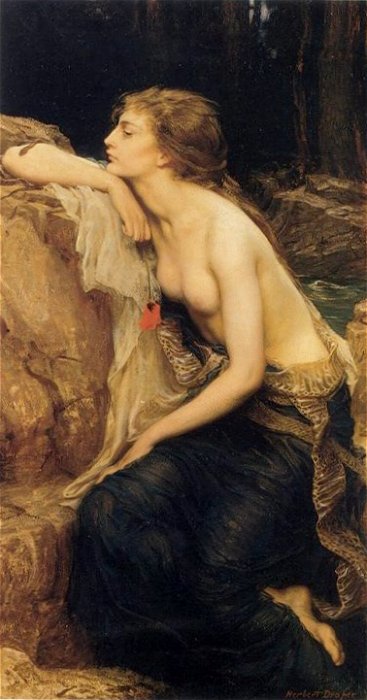
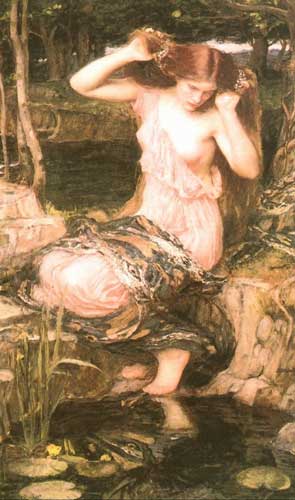
She was a popular subject for the Preraphaelite painters (see the paintings by Herbert Draper above and John William Waterhouse to the left) and she makes an appearance as a snake turned into a human woman in a poem Lamia by John Keats, although in this case a young man falls in love with a snake who has been turned into a woman and is stricken when he discovers her true identity.

Later the name was made plural, Lamiae, and they become more of a type of female witch, vampire or succubus and work their way into folk tales often as a dangerous person a hero must encounter for information but overcome.

There may be an interesting Anglo-Saxon counterpoint in Grendel's Mother, who attacks after the death of Grendel and must be overcome by the hero Beowulf and by that account the any powerful or sensual women with ambiguous motives in Arthurian legends would fit as well.

The name Velvets for the group, type of creature that they are, is very evocative. I admit the first time I heard it the Byron poem popped into my head, "She walks in beauty like the night. . ."

I would hate to minimize Lamia in Neverwhere to a mere type. The complexity and variety of these representations means the actress playing Lamia will have a lot of room for interpretation. Interestingly, the production has double casting so the same actress will be playing both Jessica and Lamia which will allow for some interesting resonances in thinking about Richard's relationship to women.