Thursday, February 25, 2010

Islington: Angels Above and Below

Before I proceed I just want to stop any readers (this assumes there are readers beyond Paul and myself and cast and crew but just in case) who might not yet have read the book or seen the television series or play because I don't want to spoil any particular plot points.

The most obvious counterpoint to the Angel Islington is Satan in Milton's Paradise Lost. In fact most people fail to realize that much of the what are thought of as canonical representations of angels in Christianity come from Milton and his efforts to “justify the ways of God to man”. If an angel is meant to be a creature of understanding and abilities far surpassing those of humans it is not surprising that an angel might overreach and grasp at some greater glory. What has always interested me about Paradise Lost is the way Milton seems put some compelling arguments in the mouth of his Satan. This Satan is more akin to a Renaissance humanist who is seeking more knowledge and broader vistas and finds himself chafing at restrictions. In Islington one feels this same strain.

When we first see Islington it's clothing is white and reflective only the eyes are dark. Gaiman carefully uses the neutral pronoun and in many ways it is preferable not only does Islington have an androgynous beauty. Like other beings that populate London below it is not human it is a creature and with any creature that is not human there is a sense of mystery about the motivations and drives which may not be human. Islington gives Richard and Door wine from Atlantis which, switching mythological metaphors to the Greek, is like ambrosia, the drink of the gods which was reserved for the gods and forbidden to humans or at a stretch like the fruit of the tree of knowledge of good and evil. Over-reachers have to trouble enticing others to over reach themselves. Richard and Door are intoxicated by the drink and ill prepared to handle its effects. They would have made easy prey for Croup and Vandemar if the pair’s instructions had not already changed (although they would have made easy prey for Croup and Vandemar anyway on the way to Islington).

It also becomes clear that Islington was the angel responsible for Atlantis and is implicated in some way in its fall. Atlantis, the city reputed to have created technologies and arts beyond those of any neighboring societies. It feels like the tower of Babel, the Biblical tower meant to reach to heaven that was destroyed and the builders punished by suddenly speaking different languages. Down Street is described as looking like a painting of Babel Tower turned outside in.

Striving after too much knowledge is punished. But it is not just the striving, but striving with the idea of making oneself like a god. That is why overreaching angels, drinkers of ambrosia and eaters of knowledge fruit must be punished. Their attempts to build towers to heaven threaten the diving order. Also the means by which they seek to attain their ends are often morally questionable. In Greek tragedies, it is the hubris of the central character that brings about fall from a great height.

I am also suddenly reminded of a story I heard about Milton and the control of knowledge. He taught his daughters how to pronounce words in Latin and Greek but not the meaning of the words so that late in life when he was blind they could read to him but without knowledge of what they read. (This is apparently from Professor Philip Gough but I think I heard it in a lecture some years ago.) It is the extreme opposite the transmission of knowledge, a ghastly punishment to prevent the inadvertent transmission of knowledge he might have considered unsuitable for women. It is a story that has always bothered the author of a great work of literature treating his own daughters so shabbily. Perhaps that is why Islington is so terrible it is disconcerting to see the beautiful do something so ugly.

When we first see Islington it is post-punishment. He is in his prison and that first journey to him is relatively easy but the return visit is a descent into the deepest and most dangerous part of London below. It is like a reverse tower of Babel descending below London or the levels Dante's Inferno.

Finally, there are a couple of other ideas that seem to resonate well with Islington. Guy Fawkes and the 1605 Gunpowder Plot and the Wim Wenders Film Wings of Desire. The Gunpowder plot is nice because it did take place underground in the cellars against a joint religious/sovereign authority in King James I. Wings of Desire pops into my head anytime angels are mentioned in popular culture because of the stark mostly black and white film making of angels in cold war Berlin observing and recording are such strong visuals that they stay in the memory. It also ties angels to a city in this case Berlin and I would argue that London (or a variety of London’s from different time periods) is a character Neverwhere. The angels in Wings of Desire are very different so I won’t push the metaphor too far but they are urban modern angels with long histories and it is fascinating to see them represented on film.

It strikes me that Islington is like another Renaissance figure, Niccolo Machiavelli, whose book The Prince was the first how to succeed at any cost self-help manual. Islington is quite successfully pulling strings from a distance and keeping his hands and his white robes clean. It is the slightly shady Marquis de Carabas who recognizes that there are larger machinations at work in the assassination of Door’s family.

Islington as a north London neighborhood is known for gentrification and being the home of former British Prime Minister Tony Blair. According to the Oxford English Dictionary, “Islington Person” became a term for a socially aware middle-class person with center-left views or left views that supposedly characterized residents of Islington. Certainly being upwardly mobile, politically connected seems to fit with the Angel Islington. Of course there is the Angel tube stop in Islington, which was apparently named for the Angel Inn a pub that dated to the mid-1600s. So this brings clever naming of characters based on London place names continues and brings me back to earth after flights of fancy. Paul published some great pictures of the tube station in an earlier post so be sure to go back and look at them.

Okay I have just edited this today (2/26/2010) because I discovered more about the etymology of Islington that was not in the OED. It actually comes from either of a couple of Anglo-Saxon words Gislandune meaning Gisel "hostage" and dun "hill" or Isendone which is from isel "lower" and don "a fortified enclosure" so Angel Islingdon would (of course) be that fortified low place where you might keep an angel hostage.


Reading Round Two and the Labels

I was unable to attend last night's reading with Paul and Rob. I had a production meeting for another play and my good Scandinavian conscience and middle class work ethic would not let me skip it.

The Wednesday night reading was advertised as a family night. We arrived and my fears that I might be expected to produce a child before entering the auditorium were allayed as the nice Napervillians let us in sans progeny.

I did not take any spiffy photos and Paul has talked about his experience so well that I will attempt not to repeat him other than to say that it is lovely to hear an author's voice, particularly when he is as good an interpreter of his own work as Gaiman. We were treated to hearing a chapter from Good Omens, the entire volume of The Wolves in the Walls and we also got to hear the forthcoming Instructions with a slide show of Charles Vess's art. I must also add that it is fun to be in an audience with young fans as they ask interesting questions about nightmares.

However, being in a fan with younger audience members also led me to think about the sorts of categorizations that are applied to reading material in sometimes unfortunate ways. I can understand that for a parent it may be useful to understand the age range or content of a book. What baffles me is the sense of condescension that seems implied when the words "children's" or "young adult" or "fantasy" are applied. It also struck me that given the breadth of ages in the audience that readers know those labels are misapplied. I suppose they seek out good writing or personal resonances.

I was reminded me of a moment shortly after I learned I was lucky enough to be dramaturg for this production of Neverwhere that I overheard a conversation in the ladies room of Lifeline Theatre. Several women were discussing how excited they were to see Neverwhere on stage and as I emerged from the stall I saw that all three of them had grey hair. It made me so happy to see them and is a great reminder about how art often defies easy categorization much as people do. I was so pleased to read Rob's post about the challenges of adaptation and Paul's thoughts on respect for the source material. It is nice to feel the shared respect for the story and similarly respect for the audiences who also love this story.

This feels rather like a rant-ish digression. More character research will be forthcoming.

Wednesday, February 24, 2010

The Director's Cut

Last night Rob and I got to see Neil Gaiman in the flesh, thanks to a cousin of a friend snagging some extra tickets for the annual Naperville Reads event, featuring Neil this year. We arrived with our copies of NEVERWHERE in tow, in case there would be a book signing, and just soaked in the ambiance of the pre-event buzz building around us.


Probably close to 450 - 500 people were packing in the Waubonsie Valley High School auditorium.  I was lamenting to Rob that we should have postcards and banners promoting the show everywhere - so many avid and adoring fans of Gaiman's work right here and NONE of them, at least MOST of them, have no idea that they could see a flesh and blood NEVERWHERE not an hour's drive away. Maybe Gaiman would mention it himself? There was a Q&A as part of the meeting, how could we gracefully promote ourselves?

Once the man came out and got to the podium, a spell was cast and any thought of marketing to this gathering of the faithful went furthest from my mind.  He is so charming and present and his sense of humor so warm and inviting, I just settled back to enjoy the art on display.  He read a chapter from Stardust which was a delightful revisiting, having worked on a stage adaptation of it back in 2005 as a movement coach.  He then read a chapter from Anansi Boys, the one that begins with the incredible layers of describing Fat Charley's epic hangover, and the audience was rapt.

And then the lights came up and Neil did a half hour of Q&A.  The line was long quickly so I just sat and watched. Someone asked about the process of writing NEVERWHERE, and while it isn't news (Neil has written and been interviewed about this a lot) it is interesting to see how even 15 years later, the pain and frustration of writing the TV series is still very powerful for him.

How about that? The director's cut.

His book will always be definitive, of course. We are making a theatrical adaptation of his book not because we think the source needs any improving or we want to re-imagine his story in any way but because we love the story and want to bring it to physical life.  We want to play in that world, say those words, believe in that storytelling power to transport us outside of our known into the new. We respect the work, respect his process and in OUR process we do have to cut and change things.

We cannot have a giant boar set loose in the theatre, so we have to find a creative solution to making the boar feel right, feel like Neil wants us to feel when we read his words. What we can't achieve in pure details that our imagination conjures up when reading Neil's work, we will evoke and inspire our audience to create with us.

Neil ended with a reading of his poem Instructions, which will be published with new artwork by Charles Vess later this Spring. I wanted to record it but it is so beautiful and magical I just wanted to listen.  It is an invitation to living creatively and courageously. Here is a clip I found of him reading it elsewhere... enjoy.


Saturday, February 20, 2010

Lamia and the Velvets


It seems like the interest in vampires and their role in popular culture returns cyclically. There was a recent Op Ed piece in the New York Times about the current popularity of vampires and their history written by Guillermo del Toro and Chuck Hogan that is well worth reading.

I actually read Dracula for the first time just a few years ago and was surprised and delighted both by the style of the novel and the characterizations. The Count is suave but as a vampire he does not seem at all sensual which seems to be an innovation of the films or a return to the Polidori story. He is more often described as a sated, fattened tick. If anything Dracula seems more like commentary on old fattened ruling classes being thwarted by a rising middle class (a doctor, a lawyer, a professor and a clever woman). However, there are also in the novel the women, first those Harker encounters while staying with the Count, and then Lucy, they do seem both sensual and dangerous, and no doubt an argument could be made about the threat of women's changing social roles in Dracula but I have already digressed far enough.

In Neverwhere, the Velvets, particularly Lamia, have more in common with these women than the new vampire craze. It is also ambiguous whether they are vampires in the traditional sense at all since Lamia speaks of being cold and it is more the stealing of warmth, breath and life rather than blood. They are more reflective of a temptation, a desire to be flattered and any good hero has to face temptation. This is why Richard is easily beguiled both by his willingness to still expect good from others and by the temptation to feel like he is capable and has some measure of control, especially after having gone through the ordeal and having been so lost in London below. He wants to assert himself and a Lamia makes him feel like that is possible. Alternately, it does not seem like they are intrinsically evil, they are more like alluring carnivorous plants that are designed to attract what they need to live but that it has as much to do with the victim as the victimizer.

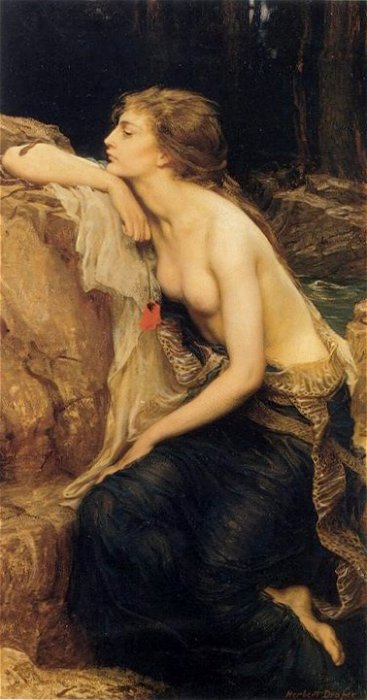
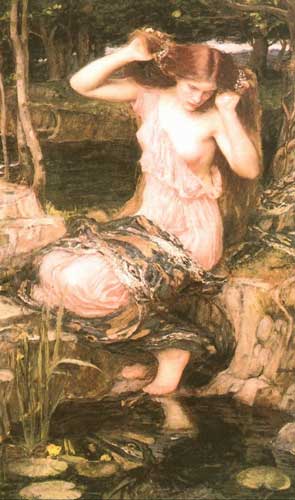
Since I can't resist thinking about names, Lamia is a minor demigod in Greek mythology with a tangled story. One of many of Zeus's seductions her children were taken by an angry Hera and she went mad and began killing (ore eating) other children. As punishment she was turned into a snake (or a half-snake and in some versions)and cursed with second sight but unable to close her eyes. Among her children are the monster Scylla but sometimes other monsters as well.

She was a popular subject for the Preraphaelite painters (see the paintings by Herbert Draper above and John William Waterhouse to the left) and she makes an appearance as a snake turned into a human woman in a poem Lamia by John Keats, although in this case a young man falls in love with a snake who has been turned into a woman and is stricken when he discovers her true identity.

Later the name was made plural, Lamiae, and they become more of a type of female witch, vampire or succubus and work their way into folk tales often as a dangerous person a hero must encounter for information but overcome.

There may be an interesting Anglo-Saxon counterpoint in Grendel's Mother, who attacks after the death of Grendel and must be overcome by the hero Beowulf and by that account the any powerful or sensual women with ambiguous motives in Arthurian legends would fit as well.

The name Velvets for the group, type of creature that they are, is very evocative. I admit the first time I heard it the Byron poem popped into my head, "She walks in beauty like the night. . ."

I would hate to minimize Lamia in Neverwhere to a mere type. The complexity and variety of these representations means the actress playing Lamia will have a lot of room for interpretation. Interestingly, the production has double casting so the same actress will be playing both Jessica and Lamia which will allow for some interesting resonances in thinking about Richard's relationship to women.

Friday, February 19, 2010

A glimpse into fight choreography

From Paul: Richard Gilbert, one of the members of R&D Choreography (with David Bareford) our fight designers for the show, weighs in with his excitement and thoughts on the process.

A long while back, I got a call from Paul, the director.  "We're doing an adaptation of Neverwhere.  Rob is adapting, I am directing.  It is going to be a while, and we can't talk about it publicly until we get some details worked out, but would you guys be interested in designing the violence?"  OK, I am making up pretty much everything after the word Neverwhere.  Because, you see, I didn't really _hear_ anything after that over the screaming "YES!!!" that was trying to escape my brain.  I hope that's what he said, because I did, of course, say yes.  And I didn't tell anyone for a few days.  Well, except my fiance, who I swore to secrecy.  She tried to make it clear that she was more excited for me than jealous.  With remarkable success, considering.

So that went on for a while.  I reread the book.  I got the first draft of the script and read that a few time through.  And then David and I started talking about the design.  There is so much to consider for this, and it ranges pretty widely.  And of course it interfaces with the other design elements - weapons are also props, so decisions about what someone fights with says a lot about who they are.  Blood - it is so intrinsic to the story ("lovely, wet blood, Mr. C") but it does funny things on stage - it can overshadow an important moment, or it can reinforce it beautifully as it drips quietly from a nostril.  But costumes are the most likely to be affected by blood.  Lights, Set, Puppets and Projections - all of these are interdependent with the violence.  

How the actors move will influence those decisions, but then once choreography is designed that will come back around and inform some of the actors' choices.   So we start out asking the questions and waiting to see what sticks.  Are the bodyguards' 'knacks' magic?  How do Croup and Vandemar move so quickly without appearing to rush in the live theatre?  If we figure that one out, how do we apply it in their fights?  Hunter's weapons should be simple, because she is practical.  Or they should be ornate, each one a trophy from some distant land where she killed a great beast.  Vandemar is a big guy - he needs a big knife.  Or wait, maybe a tiny little knife?  I can see him explaining, "People think its how big the knife is that matters.  It's not."  The spear....ok, the spear is a big deal.  It appears relatively briefly, and it is in exactly one fight...but it is a powerful artifact, so it should look cool...  Oh, right...that one big fight.  The one with the beast.  How do we make that look cool and scary?  It was already scaring me - I couldn't bear it if it looked weak and goofy in the end, and my favorite seat in the house is going to be six feet from the beast's death!  

At the first couple production meetings we saw so much beautiful thinking from every corner, and that started shaping decisions.  We brought a big bag of weapons to the second meeting and looked at what various choices would mean.  Some of it is obvious - the quarterstaff fight with Brother Sable is a quarterstaff fight.  But Hunter's staff should be a little different - maybe shorter (which will give us more room in tight quarters, and will also mean a more oriental style than Sable's European stick fighting). 

Here was an interesting evolution: for the bodyguard fight we were seeing machetes - I love the shower of sparks, and the ferocious brutality of a machete.  On the other hand, the fop should, by all rights, have a smallsword.  On the other other hand, as much fun as the fight in Rob Roy is, I don't want the fight to be about the superiority of one weapon style over another, but rather of one fighter over another - so I want the weapons to match.  Paul solved that problem - he loved our WWI bayonet.  It looks and could be held like a smallsword...and it is definitely a wicked shiv... but if has the meat to stand up to a machete blow for slashing blow!  So there, that does that.  But wait - every choice informs other choices...and look what we just did.  The Fop has this Bayonet that he thinks of as a sword, but when the fighting starts, he abandons his 18th century stance and starts hacking away... so the foppishness comes across as a thin veneer.  Lets see what the actor does with that!

Well, enough for now - so many things to work out!

A decade-long journey nears an end (and a beginning)

From Paul: I asked our award winning adaptor Robert Kauzlaric to contribute some insight into his process for this blog. 

There’s so much to discuss about this project, and Paul and Maren have already done an amazing job of that here. As the adaptor of the show, there are load of things on my mind I’m hoping to blather about on this blog, in particular: the rewards and challenges of working with such well-known and well-loved material – what do you cut? what do you keep? how do you stay true to the story while transposing it to a new medium with an entirely different set of restrictions/challenges/etc.  But before I attempt to open that can of discussion-worms, I thought it might be appropriate to share a little background on how I arrived at this point.

It was over 10 years ago that a friend first handed me a copy of Neverwhere with an off-hand, “This seems like it’d be right up your alley.” Indeed it was. I devoured it in a couple of days. Then I read it again. I had to put it away for a while out of necessity, but it kept churning in the back of my mind for months. I couldn’t get the insane notion out of my head that it would make for an amazing piece of theater I just couldn’t figure out what company would be willing to tackle it, much less let me adapt it for them.

Then, in early 2000, I saw Lifeline’s production of The Two Towers (the first MainStage show I ever saw here) and knew I’d found a place that would be insane enough to do it. And that they’d do it right: with love and respect for the source; with love and respect of the audience; with heart, humor, danger, and passion.  Later that year, I was cast in The Silver Chair, and I got my first exposure to the Lifeline process, from an early reading of the script, through auditions, rehearsals, tech, and production… and I knew it was exactly the kind of process in which I would like to see it develop.

So, without any reason to suspect that my secret plan (known only to me) to have my hypothetical adaptation of Neverwhere get produced at Lifeline would, in a million years, actually, possibly, maybe, ever happen… I got right to work on my script.  I had no idea if rights were available. I had no serious hope that anyone would actually produce it. But that didn’t really matter to me. I was feeling wildly optimistic. Not even a beating from Mr. Vandemar could have stopped me.

I finished my first draft and sent it off to some close friends who were willing to give me feedback and help me wrap my head around what I’d gotten myself into. Several months later, draft two was read aloud by a circle of friends, and I got more valuable feedback. Rinse and repeat with draft three. I’m so indebted to those friends of nearly a decade ago (circa 2001) who helped to nurture this project even when it didn’t have a hope of ever getting produced (except in my mind). Some of those friends have since moved away from Chicago, but their influence is still felt by me every time I pore through the script. (Thanks to Chris, John, Dan, Gail, Cath, Tom, Matt, Mark, Mark, Elise, and everyone I’m forgetting.)

Then I sent the script around to some director friends, and some companies I had closer relationships with at the time. The feedback was positive, but I heard a lot of, “This is cool, but seems a bit impossible. Good luck getting it produced!” Heartache ensued. The script idled on my computer as I turned my attention to other projects for a while.

In 2002, I attended one of Mr. Gaiman’s readings on the American Gods tour and was blown away by the sheer awesomeness of the experience (if you haven’t seen him read his own work yet, DO SO). I got my book signed, shook his hand, chatted with him ever-so-briefly, and wondered if my dream of adapting Neverwhere would ever happen.

In 2003, nursing a broken leg, I finally found DVD copies of the original BBC miniseries and devoured all six hours and all of the commentary. Trapped on my sofa with a full leg cast and my cats for company, I lost myself in London Below once more and began, admittedly, to mourn my dream of adapting the piece for the stage. The possibility seemed such an unattainable long-shot at that point. Perhaps the painkillers were making me excessively maudlin, but I started to fear my secret little dream would never be realized.

But by early 2005, I had appeared in six productions at Lifeline, and had finally established an actual ongoing relationship with the ensemble. The time was right to formally submit the script to the theatre. My hopes were high. I got feedback from more friends about the script. I re-edited the script. I sent off the script. And waited.

And waited.

Finally, as it turns out, the rights weren’t available. And, in any event, the timing wasn’t right for the ensemble to get behind it. The company only knew me as an actor. I hadn’t made a strong enough push to establish myself as a writer in their eyes. Nor (in retrospect), had I truly attempted to convey the full extend of my excitement about the project to them. I was hugely disappointed at the time, but I get it now.

Later that year, I was honored to be asked to join the company and got my first direct exposure to the script-selection process from the “inside. About a year later, I got my first writing opportunity with the company: a KidSeries musical adaptation of The True Story of the 3 Little Pigs! Time passed. Paul and I tackled The Island of Dr. Moreau. I dove into the world of Oscar Wilde with The Picture of Dorian Gray. And by mid-2008 or so (if I have my timing correct), I re-introduced the company to my Neverwhere idea and by this time there was interest, trust and solid support. And in Paul, I had the perfect director-partner committed to seeing the project through with me. All we needed was to get the rights.

And then last year, they came through.

And there was celebration.

So, in January of 2009, nearly 10 years after I first started working on my script, I dove back in. We held a reading with the ensemble and with their invaluable feedback, a brand new draft emerged. This past summer, we cast the show. In early December, we held another reading with the cast and ensemble, and brought the production team in on the discussions. Again, everyone’s insights were invaluable. And Paul and I met repeatedly for a month to discuss character, direction, tone, theme, style and all that other great theatre-type stuff.

Now, here I sit in February of 2010, a mere two weeks away from the beginning of the rehearsal process. We’ve got an amazing cast and design team, all geeked to the gills about working on such wonderful source material. The long, SOLITARY portion of my journey is over as the project now gets placed in the capable hands of a massive TEAM of people, all working to tell the story, hone the production, and realize the theatrical vision of the piece.

And I, for one, couldn’t be more excited to see how it all turns out.

Thursday, February 18, 2010

Character Study: Hunter


I wanted to pause and explain the brief character studies that I am posting. When you read a book you take the characters as they are written. When an actor brings a character to life on stage there is additional material that may help the actor create a convincing portrayal of a character that is not on the page. If a character is a historical figure then there are biographical accounts to help a character construct a role but when the character is fictional it is more complicated.

In the case of the characters in Neverwhere, Paul and I have been discussing the fairy tale or mythological figures that inform the some of the characters as source materials for the actors.

Hunter: The name itself is shows the simplicity of early naming. In which person was defined by a job such as Miller, Smith, Wright would have referred to the miller the smith and the wheelwright or cartwright. (Hammmersmith, another character in Neverwhere is similarly named and as Hunter is a hunter he is indeed a metal smith).

In addition to the simplicity of her name Hunter feels ancient and her motivations seem very primal, taciturn and therefore mysterious. She has excellent mythological predecessors the Greek/Roman goddess Diana/Artemis, a virgin dedicated to the hunt. The Diana of Anet by Goujon is shown above.

The Amazons, known more as warriors than hunters but recognized for their fierceness in battle and apocryphally for cutting off one breast to make it easier to string their arrows. Penthesilea and Hippolyta are perhaps the best known of the Amazons the former having been involved in the Trojan War and the later appears in the labors of Hercules and later revived by Shakespeare as a character in A Midsummer Night's Dream.

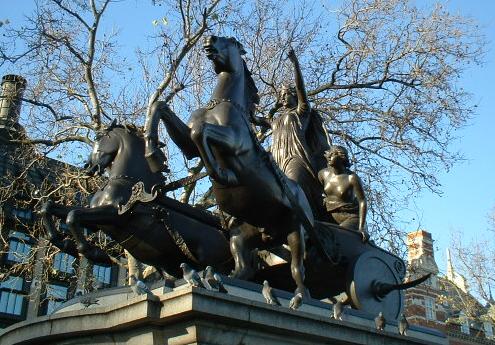
There is also an early Briton analog in the warrior queen Boudicca (sometimes written as Boadicea) who led a rebellion against Roman occupiers. The Anglo-Saxons had a belief in the fundamental danger of nature and an afterlife that consisted mostly in the praise and after-singing of the people who still lived and would sing of your great deeds. Pictured above is a statue by Thomas Thorncroft of the warrior queen which is, appropriately, in London. Which seems to fit with Hunter's valuing most highly her deeds.

That she is hunting the beast of London also evokes various mythological references. In the Mabinogion (I know I keep referring to this it really is a fantastic source - sorry) Culhwch kills a boar as one of the tasks he must fulfill to win his bride Olwen. Hercules kills the Erymanthian Boar. A unique twist on on the boar in mythology is the Norse goddess Freya, who is sometime portrayed riding the boar, Hildisvini, into battle rather than attacking the creature. This is not to say the beast of London is necessarily meant to be a boar but to give just a few examples of the monsters that must be killed by a hero or the relationship of a beast to some sort of immortality. The beast leads me to the reluctant hero Richard Mayhew but I will save him for another day.